Craft Basics


Displays products in a grid view
Displays products in a detail view
Shop All Craft Basics
410 products
+ 5 Options
SKS Props HD-Foam Rolls
+ 5 Options
Item #: 84900
Blick Exclusive! Ideal for beginners and professionals who create quality props and costumes for cosplay, theater, and more, SKS Props HD-Foam is ...
+ 23 Options
Kunin Classic Felt Sheets
+ 23 Options
Item #: 65301
Use brilliantly colored Kunin Classic Felt Sheets in the classroom or at home for fabric crafts. It’s made in the USA from Kunin’s own 100% Eco-fi pol...
+ 3 Options
Mudtools Mudsponge
+ 3 Options
Item #: 31149
The Mudtools Mudsponge is made of biodegradable, environmentally friendly, durable materials. Great all-purpose tools for use in ceramics studios, cla...
+ 8 Options
SKS Props HD-Foam Dowels
+ 8 Options
Item #: 34842
Blick Exclusive! For beginners and professionals, SKS Props HD-Foam Dowels are made from an EVA material that is easy to cut and shape with heat. ...
+ 3 Options
Creativity Street Craft Sticks
+ 3 Options
Item #: 60401
Popsicle-size wooden sticks (3/8" x 4-1/2" or 1 cm x 12 cm). Glue them together to make bird houses, log cabins, fences, forts, rafts, trivets, name t...
+ 12 Options
Creativity Street Regular Chenille Stems
+ 12 Options
Item #: 60923
Packages of 100 craft stems (pipe cleaners). Available in individual colors, as well as assorted solid and decorative colors. Length 6" and 12". Solid...
+ 36 Options
Kunin Premium Felt
+ 36 Options
Item #: 60868
Upgrade your projects with Kunin Premium Felt. This high-quality crafting felt is wonderful for clothing and costumes, collage, classroom projects, ho...
SKS Props Lightweight Foam Clay
Item #: 34384
In stock online
Blick Exclusive! Add details to cosplay costumes, props, craft projects, and models with SKS Props Lightweight Foam Clay. Press into molds or scul...
+ 28 Options
Spectra Sparkling Crystals Glitter
+ 28 Options
Item #: 61416
Add sparkle to any project with these brilliant, bold plastic glitter crystals! They are .04 size, hexagon-shaped, non-toxic and come in convenient, n...
+ 4 Options
Wear'm Canvas Tote Bags
+ 4 Options
Item #: 15732
Wear’m Canvas Tote Bags give you a ready-to-decorate surface for embroidery, screen printing, fabric paint, iron-on vinyl, and more! Made of 100% natu...
+ 3 Options
Creativity Street Jumbo Craft Sticks
+ 3 Options
Item #: 60406
Use these Jumbo Craft Sticks for a wide variety of craft projects. Glue them together to make bird houses, log cabins, fences, forts, rafts, trivets, ...
Royal & Langnickel Super Value Sponge Set
Item #: 32934
In stock online
For pottery, ceramics, sponge painting, staining, stippling, and faux finishes. May be used with acrylic, oil, watercolor, or fabric paints. Includes...
+ 4 Options
Creativity Street Pulp Masks
+ 4 Options
Item #: 61761
Mask making is a fun way to learn about history and culture, express emotion, and create a character or to just let your imagination run wild. These m...
+ 41 Options
Smart-Fab Art and Decoration Fabric
+ 41 Options
Item #: 62500
Smart-Fab is the smart alternative to paper and cloth. Pleasantly cloth-like to the touch, it's an innovative non-woven fabric that's easy to cut, fol...
+ 41 Options
FloraCraft CraftFōM Foam Blocks and Shapes
+ 41 Options
Item #: 60928
FloraCraft CraftFoM is a featherlight material that can be used for sculpture, floral, and craft projects. Made from recycled plastic, CraftFoM is eas...
+ 3 Options
Essentials by Leisure Arts Fiber-fil Polyester Stuffing
+ 3 Options
Item #: 64975
Create new projects or enhance old ones with Essentials by Essentials by Leisure Arts Fiber-fil Polyester Stuffing. This high-quality, breathable fibe...
Art Alternatives Pottery Sponges
Item #: 32985
In stock online
Moisten, refine, and clean up ceramic and clay with Art Alternatives Pottery Sponges. Made of a durable, non-tearing synthetic material, these palm-si...
+ 3 Options
Design Works Unbleached Muslin
+ 3 Options
Item #: 63987
Made of tightly woven 100% cotton, Design Works Unbleached Muslin is a studio staple for many art, craft, and sewing projects. The high-quality natura...
+ 4 Options
Mayco Earthenware Bisque Plates
+ 4 Options
Item #: 32947
Mayco Earthenware Bisque Plates are the perfect choice for creating elegant custom dinnerware or decorative home accents. Offering ample open surface ...
+ 23 Options
Pepperell Rexlace Plastic Lacing
+ 23 Options
Item #: 60921
Pepperell Rexlace Plastic Lacing is great for a wide variety of projects, including making lanyards, key chains, zipper pulls, bracelets, barrettes, a...
+ 8 Options
Mayco Stoneware Bisque Mugs
+ 8 Options
Item #: 32796
Glaze a full set of Mayco Stoneware Bisque Mugs for your home— or invite friends over for a fun paint-and-sip evening! These unfinished bisque mugs ar...
+ 2 Options
Xiem Studio X-Sponge 2
+ 2 Options
Item #: 30277
The Xiem X-Sponge 2 has a stainless steel rod that telescopes from 8-1/2" to 26" long, making it easy to remove water from the bottom of shallow or de...
+ 9 Options
PanPastel Sofft Sponges
+ 9 Options
Item #: 21935
PanPastels Sofft Sponges are versatile applicators specially formulated for use with PanPastels as well as a wide variety of dry or wet media. These h...
Creativity Street Felt Sheet Assortment
Item #: 61753
In stock online
Creativity Street Felt Sheets are great for craft projects, embellishments, stitchery, costumes, and more. This economical pack contains 12 sheets of ...
+ 5 Options
Mayco Earthenware Bisque Mugs
+ 5 Options
Item #: 32761
Durable and functional, Mayco Earthenware Bisque Mugs are made from white earthenware bisque and come ready to customize with 05-06 glazes and undergl...
+ 12 Options
Creativity Street Wiggle Eyes
+ 12 Options
Item #: 60938
Bring your craft creations to life. Creativity Street Wiggle Eyes have a flat back for gluing and come in a variety of colors, shapes, and sizes.
+ 21 Options
Kunin Classic Felt Bolts
+ 21 Options
Item #: 83783
Kunin Classic Felt Bolts is perfect for home and school projects, camp crafts, and holiday decor. It's made with Eco-fi, a high-quality polyester fibe...
+ 25 Options
Decopatch Medium Paper Mache Animals
+ 25 Options
Item #: 12682
Create fun and inventive designs with Decopatch Medium Paper Mache Animals. These kits are available in a variety of different animals and mythical cr...
+ 4 Options
FloraCraft Desert DryFoM Foam Blocks
+ 4 Options
Item #: 33676
Lightweight and easy to work with, FloraCraft Carving Foam is neutral brown/gray in color, with a smooth, fine texture that carves like soft wood. It ...
+ 4 Options
Creativity Street WonderFoam Sheets
+ 4 Options
Item #: 60947
Create bright, glittering designs, multicultural faces and figures, and more with fun and flexible Creativity Street WonderFoam Sheets. The sheets cut...


Featured Lesson Plans

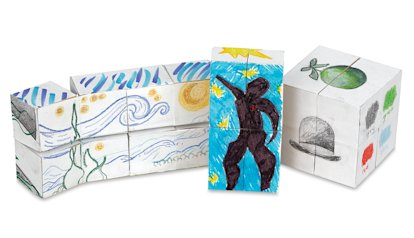
Visual language skills are put to work in this lesson plan. Students will first analyze the elements of art used in a chosen painting. Then this visual data will be transferred to a transformable cube. The cube can be flipped and folded in different directions to reveal ten different external faces, creating the perfect substrate to explore each facet of the elements of art.


Joseph Cornell's (1903-1972) most characteristic art works were boxed assemblages created from found objects. These were simple boxes in which he arranged surprising collections of photgraphs or bric-a-brac in a way that combines the formality of Constructivism with the lively fantasy of Surrealism. Students will gather pieces of nostalgia or found objects to embed in plaster within an arrangement of mini canvas "boxes".


