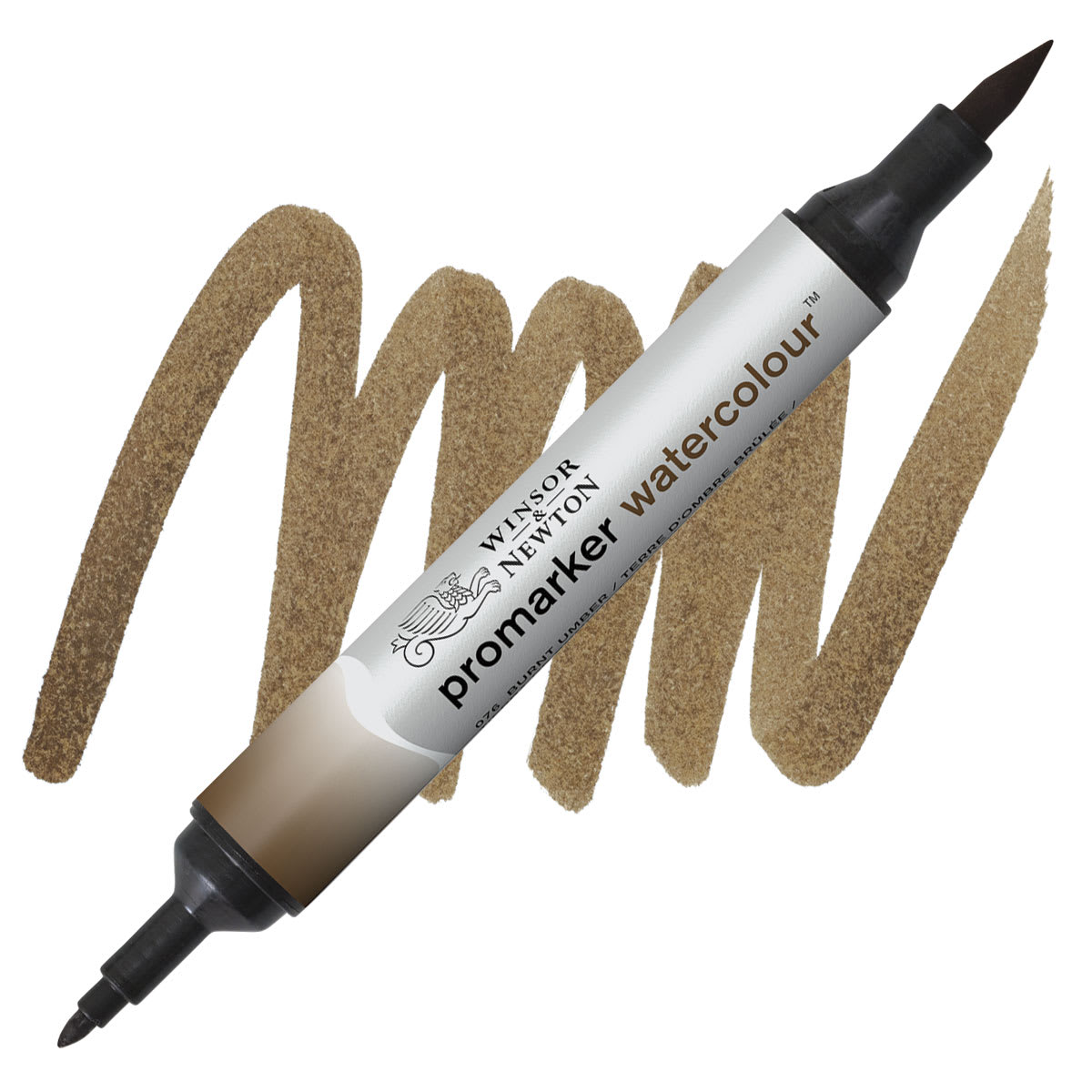
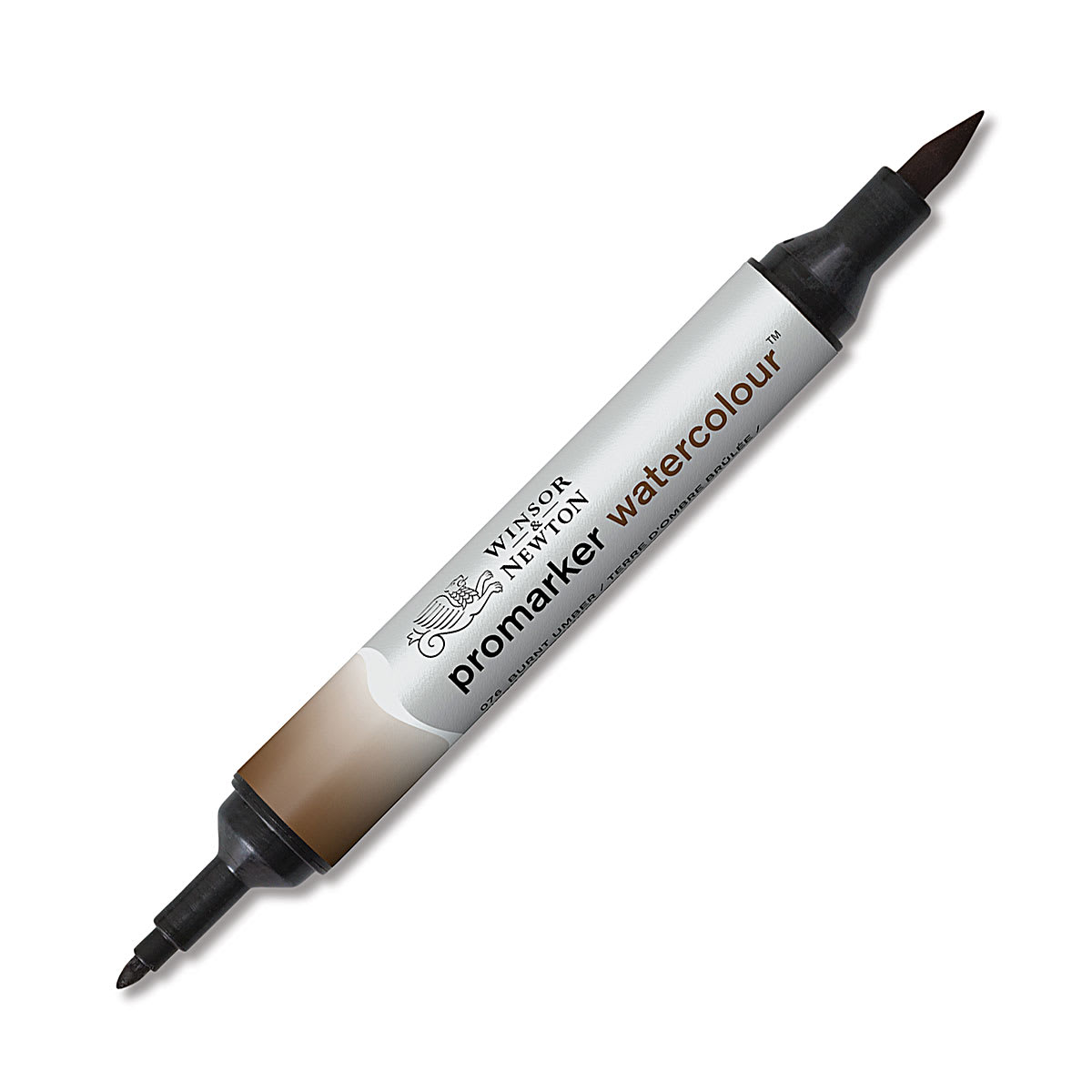
Winsor & Newton Watercolor Marker - Burnt Umber
Save For Later
My Store Pickup List
Please select a storeMy Wish Lists
My BlickU List(s)
My Quick Quotes
Product Details
- No.
- 076
- Description:
- Watercolor Marker
- Color:
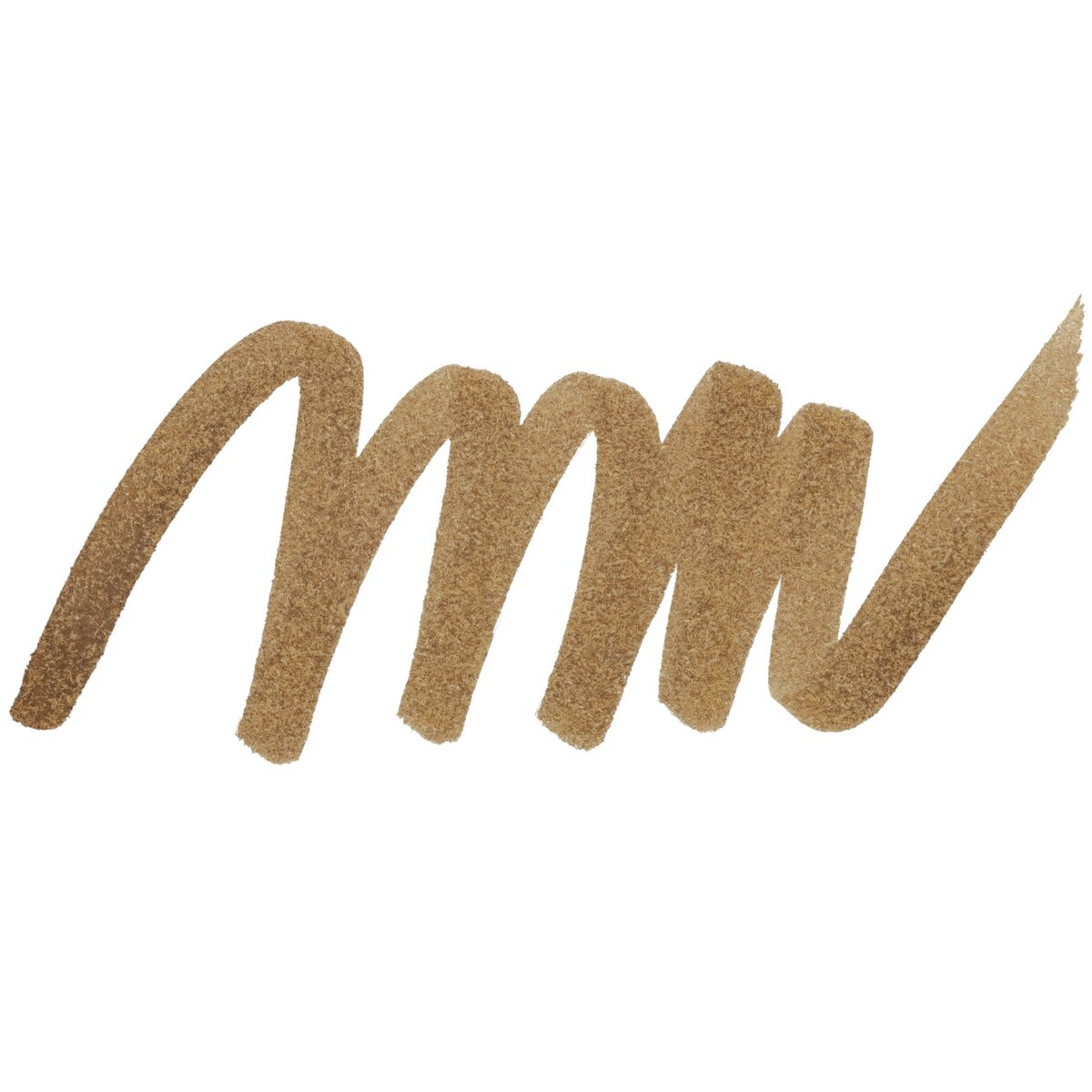
- Burnt Umber
- Nib Shape:
- Brush and Fine Tip
Shipping Note - Due to manufacturer distribution restrictions, Winsor & Newton products cannot be shipped to addresses outside of North America.
Colors on Monitors -
Due to differences in users’ monitors, the colors presented are an approximation of the true color.
Reviews
Pigment Information
This color contains the following pigments:
PBk7-Lamp Black
PBr7-Burnt Umber
PR122-Quinacridone Magenta
PY83-Diarylide Yellow 83
Pigment Name
PBk7-Lamp Black
Pigment Type
inorganic
Chemical Name
carbon
Chemical Formula
C
Properties
Lamp black is a very opaque, heavily staining black pigment that does not have much covering or tinting power. It is typically the most opaque black in watercolor form. Though a very pure black, it tends to muddy slightly in mixtures. Natural sources may be brownish or bluish in tone because of impurities. When used in oil paints, it is one of the slowest drying pigments, and should not be used in underpainting or applied in layers underneath other colors.
Permanence
Lamp Black is very lightfast and absolutely permanent. It is used in all techniques in permanent painting.
History
Lamp Black is a carbon based black traditionally produced by collecting soot (known as lampblack) from oil lamps. It has been used as a pigment since prehistoric times. It is the black found in Egyptian murals and tomb decorations and was the most popular black for fresco painting until the development of Mars Black.
Pigment Name
PBr7-Burnt Umber
Pigment Type
earth
Chemical Name
iron oxides with manganese silicates or dioxide
Chemical Formula
Fe2O3,MnO2 or Fe2O3+MnO2+nH2O+Si+Al2O3
Properties
Burnt Umber is a more intense reddish brown pigment that results from heating the clay pigment Raw Umber. It has medium to excellent tinting strength and high opacity, and it is quick drying in oil form. Burnt Umber is somewhat more transparent than Raw Umber. It has excellent color properties and can create a variety of subtle, clear tints when mixed with white. It can tend towards chalkiness in dark mixes in oil form, but overall it mixes well with other colors. To create a black color in oil form, mix Burnt Umber with Phthalo Blue or Ultramarine. To achieve a similar color in watercolor form, mix it with Ultramarine or Payne's Gray.
Permanence
Burnt Umber has good permanence.
History
This pigment gets its name from the Latin word umbra, meaning shadow or shade. Its full name is listed as terra di ombra, meaning earth of shadow/shade, due to its original extraction from the area of Umbria, Italy. It has been used as a pigment since prehistoric times. Currently, the finest umber comes from Cyprus.
Pigment Name
PR122-Quinacridone Magenta
Pigment Type
organic, quinacridone
Chemical Formula
C22H16N2O2
Properties
Quinacridone Magenta is a semi-transparent and powerful bluish red with an impressive mixing range. It makes an excellent glazing color and is one of the bluest of the Quinacridone colors. The pigment's properties vary considerably, depending on how it is ground. Quinacridone pigments have relatively low tinting strength in general. For this reason, quinacridone colors are often expensive, because more pigment is required in the formulation.
Permanence
Quinacridone Magenta offers very good lightfastness in most media, but some have argued that it is less lightfast in watercolor form. Although Quinacridone Magenta received only a passing grade of "fair" under ASTM test protocols, other test results have rated the pigment very good to excellent. Transparent reddish violet pigments in general have more problems with lightfastness than any other range of colors. PR122 is often used as the Magenta of CMYK (four color) process printing because it offers a better tradeoff between tinting strength and lightfastness than other pigments in its class.
History
Quinacridone Magenta came from a red violet aniline dye that was first produced in 1858 by Natanson. It was called Magenta to commemorate a battle in Magenta, Italy. Over time, Magenta became the standard color name for a deep, violet red. Although quinacridone compounds became known in the late 19th century, methods of manufacturing so as to make them practical for use as commercial pigments did not begin until the 1950s. PR122 has become particularly popular in the formulation of Magenta for CMYK process printing.
Pigment Name
PY83-Diarylide Yellow 83
Pigment Type
organic, disazo
Chemical Formula
C36H32Cl4N6O8
Properties
Diarylide Yellow is a semi-opaque, moderately staining, intense deep reddish yellow pigment with good tinting strength.
Permanence
Diarylide Yellow 83 has very good lightfastness and permanence. However, it can fade in tints, so some artists do not consider it suitable as an artists' color. Many other diarylide yellow pigments are reported to have fair to poor lightfastness, and some are completely fugitive. Diarylide Yellow 83 is reputed to be one of the most permanent of the entire group.
History
Diarylide Yellow comes from a family of azo pigments called Diarylide. These yellow hued pigments were developed around 1940 and are very important in printing inks.
Safety Data Sheet
UPC Code: 1088495503299
ASIN #: B00MYA1K76