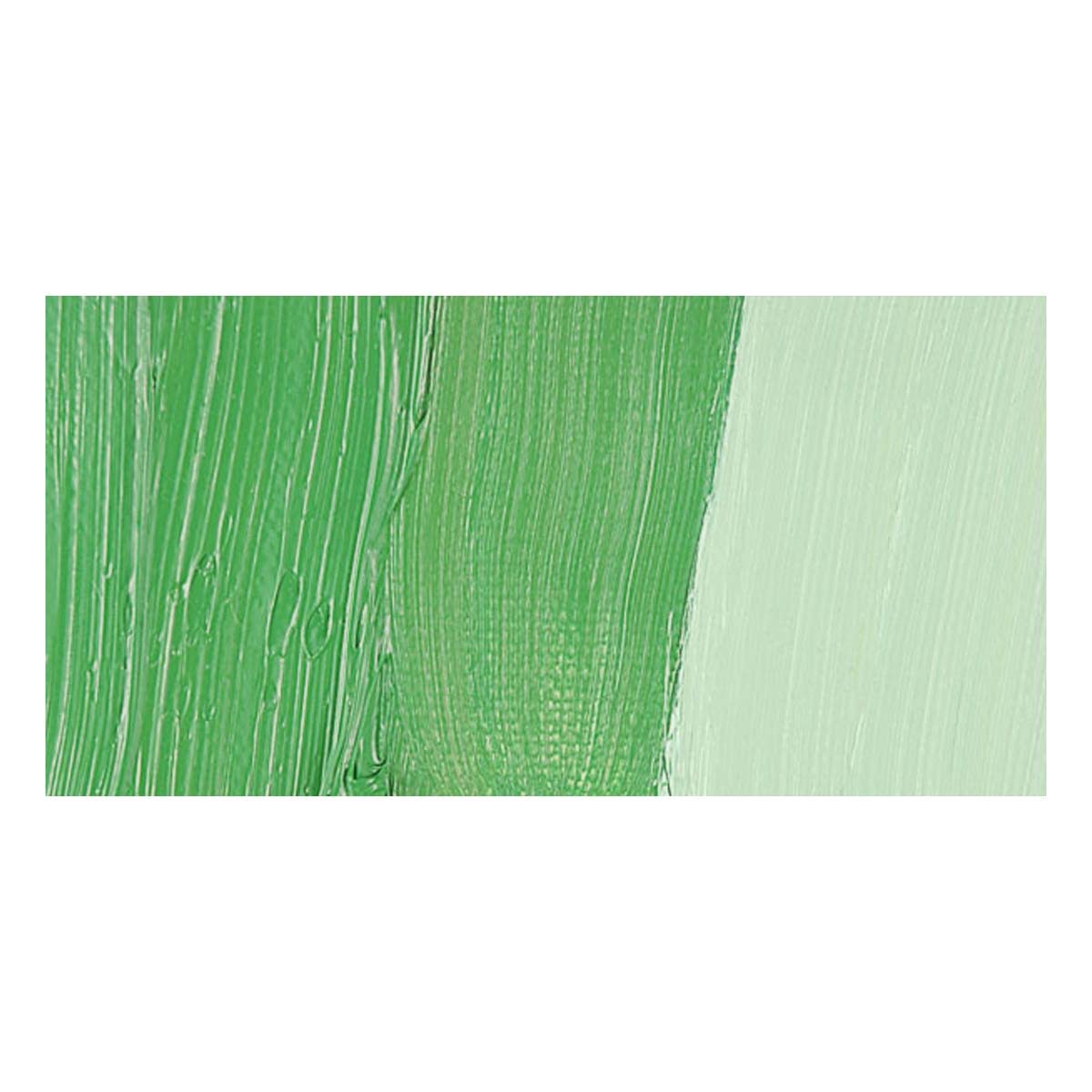
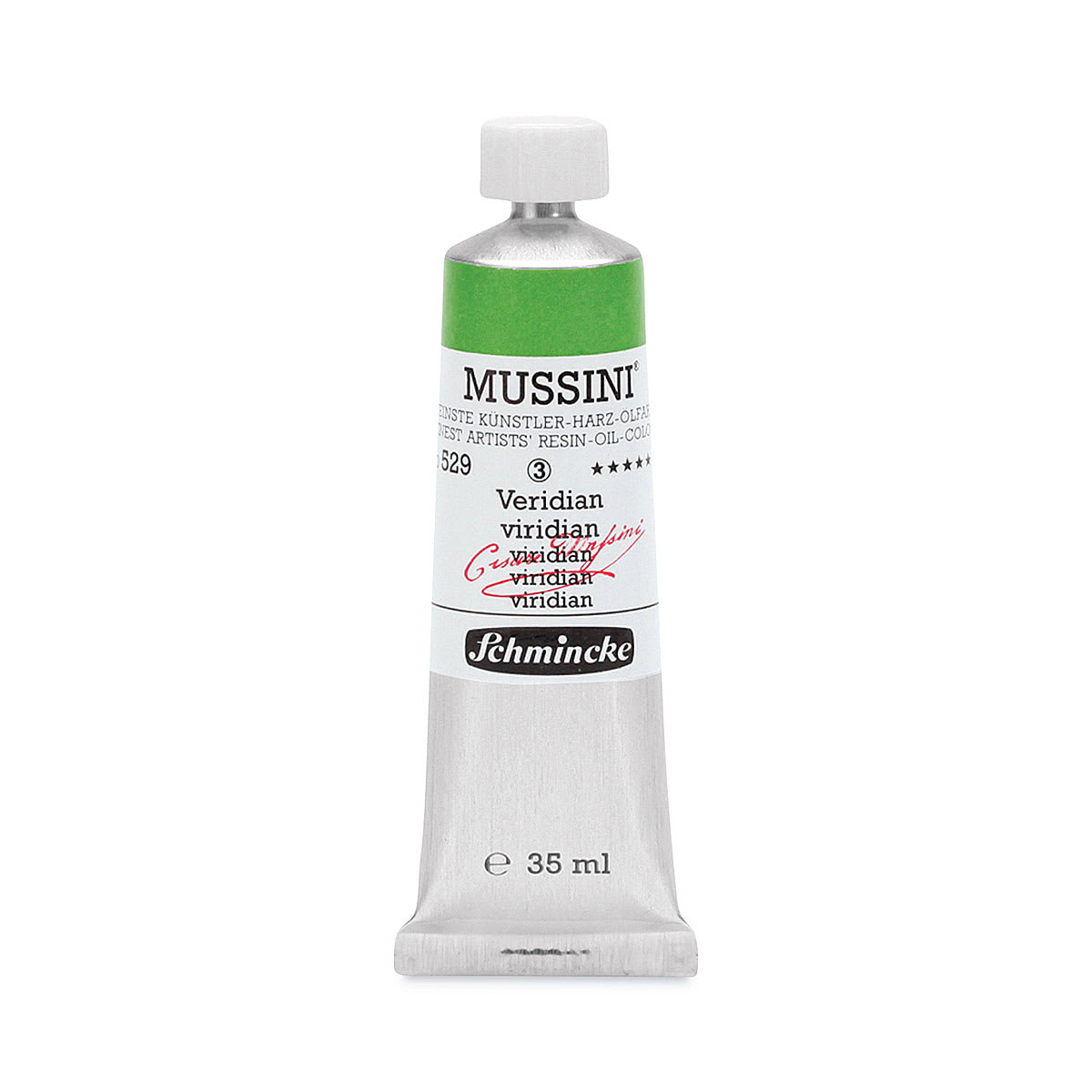
Schmincke Mussini Oil Color - Viridian, 35 ml tube

Save For Later
My Store Pickup List
Please select a storeMy Wish Lists
My BlickU List(s)
My Quick Quotes
Product Details
- No.
- 529
- Description:
- Oil Paint
- Color:
- Viridian
- Size:
- 35 ml (1.18 oz)
- Format:
- Tube
- Series:
- 3
Colors on Monitors -
Due to differences in users’ monitors, the colors presented are an approximation of the true color.
Reviews
Pigment Information
This color contains the following pigments:
PG18-Viridian
PW4-Zinc White
PY184-Bismuth Yellow
Pigment Name
PG18-Viridian
Pigment Type
inorganic
Chemical Name
chromium(III)-oxide dehydrate
Chemical Formula
Cr2O3 • 2 H2O or Cr2(OH3)
Properties
Viridian is the standard green and is stable, powerful, and cold with an emerald green undertone. It has a transparent hue, good tinting strength, a dark masstone that can be almost black at full strength, and a slow drying time in oil form. Viridian is commonly replaced by the darker, more saturated, and staining Phthalo Greens, but its properties make it a necessary part of the palette of an experienced landscape painter.
Permanence
Viridian has excellent permanence, except in high-temperature work, and is highly valued as a glazing color.
History
Viridian’s name comes from the Latin viridis, meaning green. The process for manufacturing Viridian, or Transparent Oxide of Chromium, was patented by Guignet in Paris in 1859. However, it had actually been discovered by Pannetier and Binet in 1838. Viridian replaced Verdigris, which was reactive and unstable, and Emerald Green, which was a poisonous copper aceto-arsenite used as a rat poison in the sewers of Paris.
Pigment Name
PW4-Zinc White
Pigment Type
inorganic
Chemical Name
zinc(II)-oxide
Chemical Formula
ZnO
Properties
Zinc White is the coolest white, and it has a cold, clean masstone and a slightly bluish tint. It has less hiding power and is more transparent than other whites. It dries slowly and is good for painting wet into wet and for glazing and scumbling. Zinc White is neither as opaque nor as heavy as Lead White, its covering power is not as good, and it takes much longer to dry. However, it does not blacken when exposed to sulfur in the air as Lead White does. It is very valuable for making tints with other colors. Unmixed Zinc White dries to a brittle and dry paint film that may crack over the years, so it is not good for frescoing. It is more transparent in acrylic form than Titanium White and is the most commonly used white with gouache. Chinese White is a version of Zinc White appropriate for opaque watercolor techniques.
Permanence
Zinc White has great permanence and lightfastness.
Pigment Name
PY184-Bismuth Yellow
Pigment Type
inorganic
Chemical Name
bismuth orthovanadate or bismuth vanadium oxide
Chemical Formula
BiVO4
Properties
Bismuth Yellow is an intense, light value, semi-opaque yellow pigment with good tinting strength.
Permanence
Bismuth Yellow has excellent lightfastness.
History
Bismuth orthovanadate occurs naturally in several minerals. Although it was synthesized in the 1920s, it was not developed as a commercial pigment until the 1970s.
Safety Data Sheet
UPC Code: 4012380059949
ASIN #: B0006OJC2M