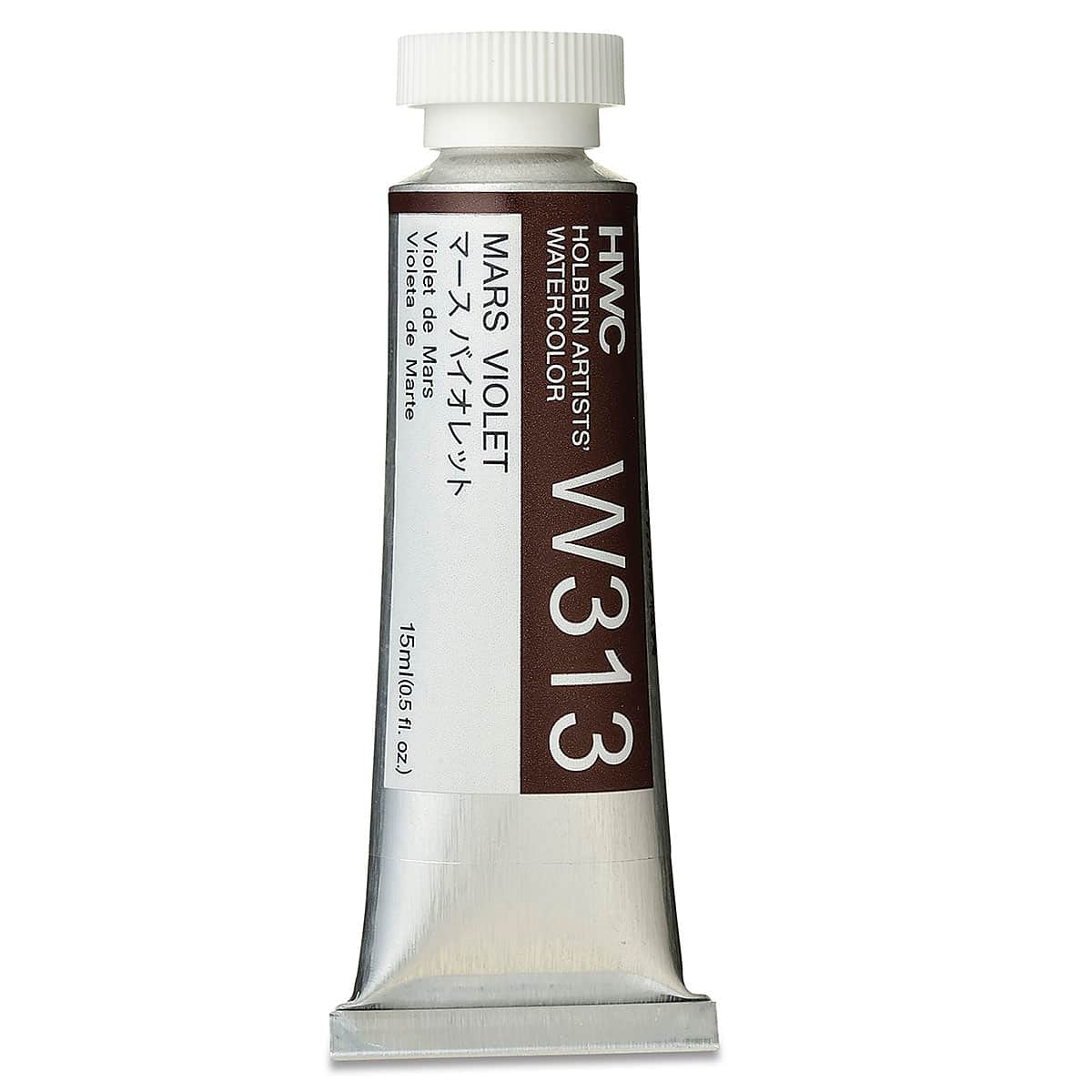
Holbein Artists' Watercolor - Mars Violet, 15 ml tube

Save For Later
My Store Pickup List
Please select a storeMy Wish Lists
My BlickU List(s)
My Quick Quotes
Product Details
- No.
- 313
- Description:
- Granulating Artists' Watercolor
- Color:
- Mars Violet
- Series:
- B
- Format:
- Tube
- Size:
- 15 ml (0.50 oz)
Colors on Monitors -
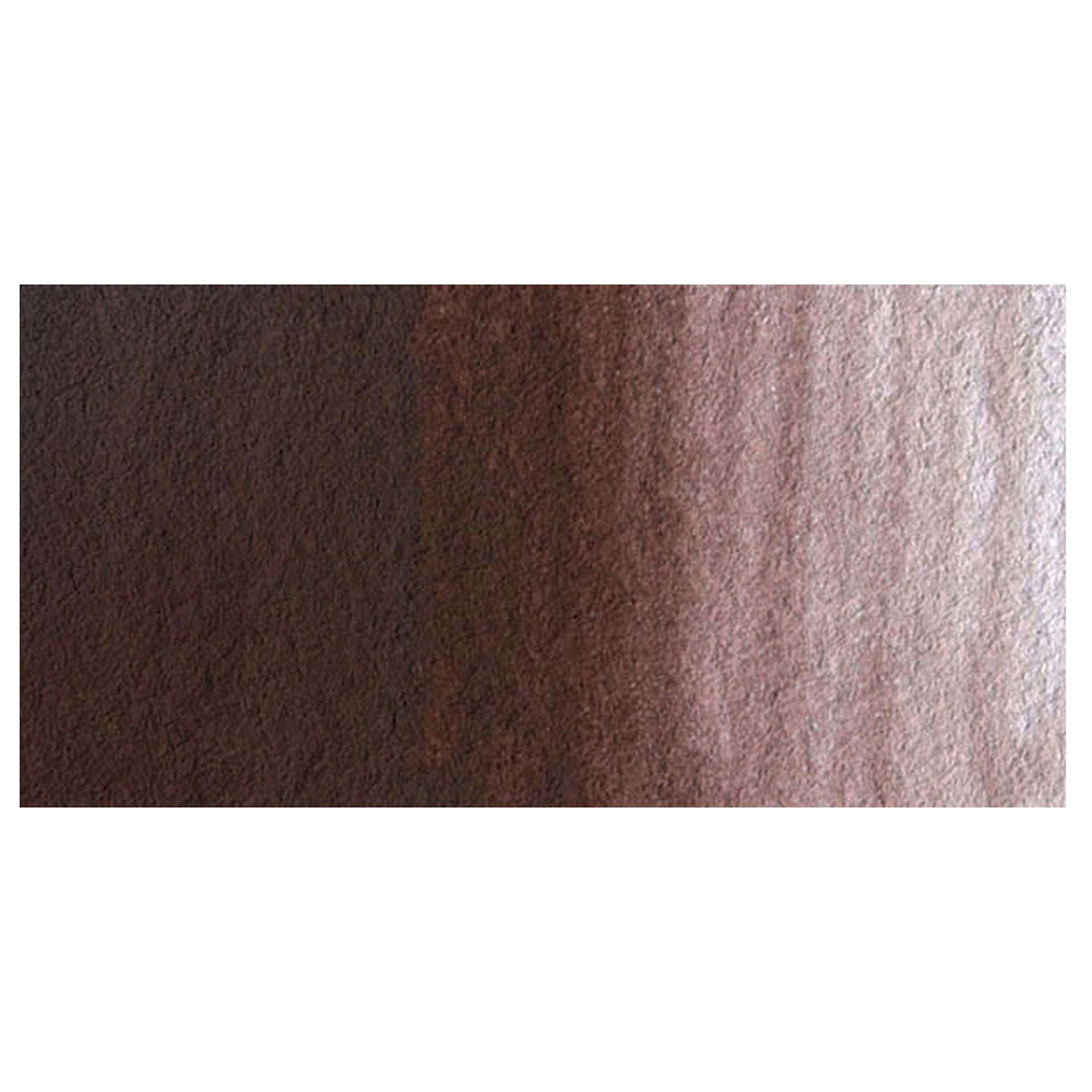
Due to differences in users’ monitors, the colors presented are an approximation of the true color.
Reviews
Pigment Information
This color contains the following pigments:
PV23-Dioxazine Violet
PBr7-Burnt Sienna
PR101-Red Iron Oxide
Pigment Name
PV23-Dioxazine Violet
Pigment Type
organic
Chemical Name
carbazole dioxazine
Chemical Formula
C34H22Cl2N4O2
Properties
Dioxazine Violet is transparent and has very high tinting strength. It is a staining pigment, very dark valued when it is used at full strength. Concentrated, it paints out nearly black, but it mixes with Titanium White to form bright, opaque tints of purple. PV23 produces slightly redder shades than PV37. Because the hue can vary with the conditions of preparation and grinding, it may be offered in red shade, blue shade, and so forth.
Permanence
Dioxazine Violet has good lightfastness. There may be some concern about it fading or shifting in color in tints and washes. Some artists have reported that PV37, a molecular variant, is more lightfast than PV23.
History
Two molecular variants of Dioxazine Violet, PV23 and PV37, are available. They have similar properties, but mix slightly differently.
Pigment Name
PBr7-Burnt Sienna
Pigment Type
earth
Chemical Name
iron oxides
Chemical Formula
Fe2O3
Properties
Burnt Sienna is a warm, mid-brown color formed by burning the yellow-brown limonite clay called Raw Sienna. It ranges from semi-opaque to semi-transparent due to the combination of its opaque, red-brown mass tone and its transparent, orangey undertone. It is an excellent mixing complement for blues and greens and creates salmon or peach colored tints when mixed with white. It can be useful for subduing bright colors and does not get chalky in dark mixtures.
Permanence
Burnt Sienna has good permanence and is considered one of the most versatile of the permanent pigments.
History
Burnt Sienna has been used as a pigment since prehistoric times, but its current name came about during the Renaissance. It comes from the city of Siena, in Italy, and is short for terra di Siena, meaning earth of Siena. Sienna was famous for the mining and production of earth pigments from the Renaissance until World War II. Due to the depletion of clay deposits in Tuscany, Italian siennas now come from other areas, including Sicily and Sardinia.
Pigment Name
PR101-Red Iron Oxide
Pigment Type
earth, synthetic
Chemical Name
iron oxides (synthetic), iron oxide, silica, alumina, lime, and magnesia or hydrated iron oxide
Chemical Formula
Fe2O2 or Fe2O3 x H2O
Properties
Red iron oxide varies in hue and transparency, depending on hydration and slight impurities. Indian Red is a slightly duller, deep brick hue with a bluish undertone. It is very dense and opaque, with excellent tinting strength and covering power. It is dependable when mixing with all other permanent pigments and yields good flesh tints when mixed with Zinc White. It is the synthetic version of PR102, which is a pigment made from earth reds, or natural red iron oxides, and the names applied to PR101 and PR102 often overlap. The synthetic red iron oxides have mostly replaced natural red iron oxides and are brighter, stronger, finer, and more permanent. Indian Red is the highest grade bluish shade. Light Red, English Red, and Venetian Red are yellowish shades. Mars Violet is a dull and subdued bluish or purplish oxide.
Permanence
Red iron oxide is very lightfast with excellent permanence.
History
Natural red iron oxide comes from the mineral ore hematite, called bloodstone by the ancient Greeks from the word hema, meaning blood. It is one of the oldest pigments, has been used by every major civilization, and was an important mineral for medieval alchemists. It was not widely used in artists' materials until the 17th century and was not produced in large quantities until the 18th century.
Safety Data Sheet
UPC Code: 4900669033134
ASIN #: B001DMQJTK