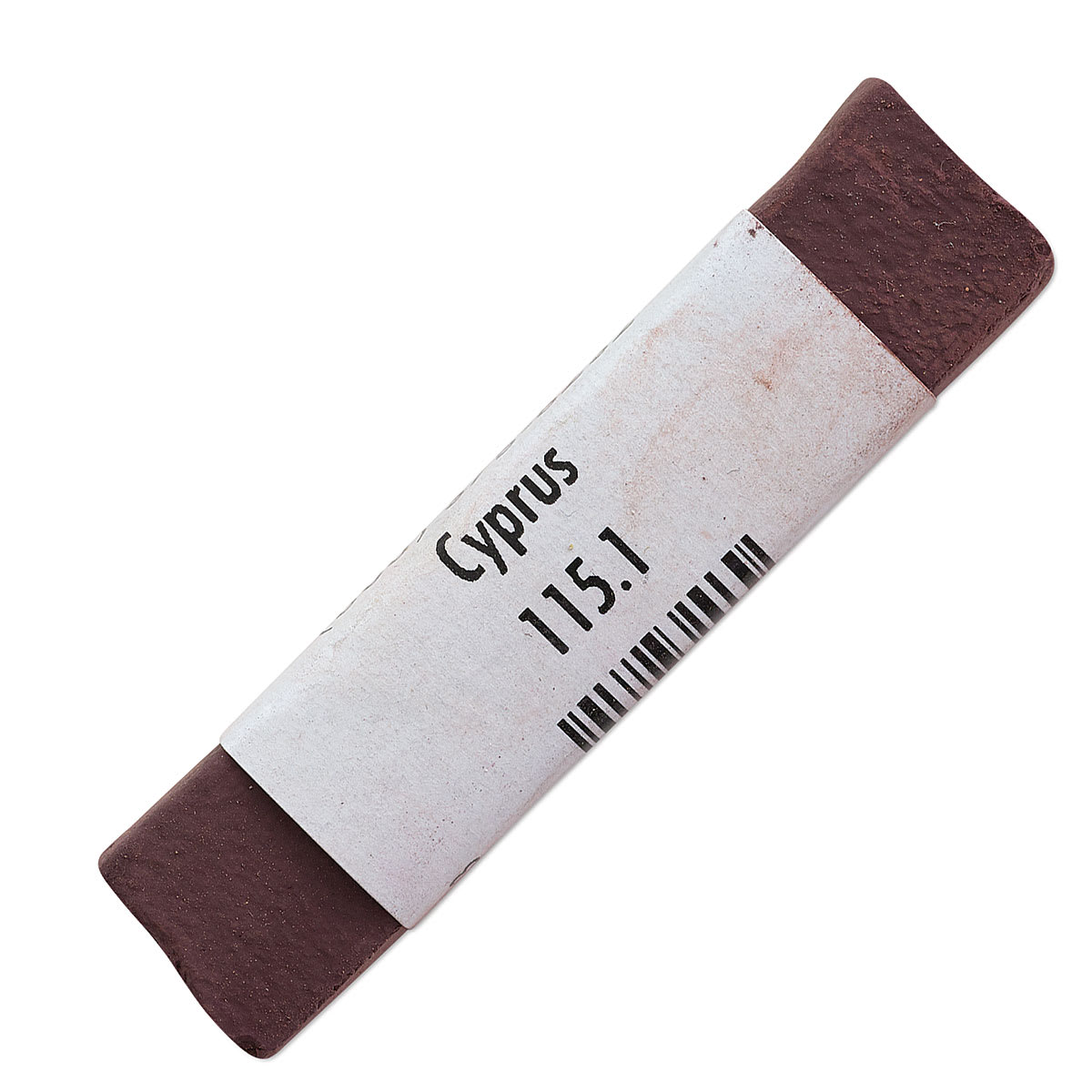
Great American Handmade Pastel - Cyprus 1, 115.1


Save For Later
My Store Pickup List
Please select a storeMy Wish Lists
My BlickU List(s)
My Quick Quotes
Product Details
- No.
- 115.1
- Description:
- Pastel
- Color:
- Cyprus 1
Set colors may vary - The vendor may substitute a color within a set due to stock issues without notice.
Colors on Monitors -
Due to differences in users’ monitors, the colors presented are an approximation of the true color.
Reviews
Pigment Information
This color contains the following pigments:
PV23-Dioxazine Violet
PW18-Calcium Carbonate
PBr7-Raw Umber
Pigment Name
PV23-Dioxazine Violet
Pigment Type
organic
Chemical Name
carbazole dioxazine
Chemical Formula
C34H22Cl2N4O2
Properties
Dioxazine Violet is transparent and has very high tinting strength. It is a staining pigment, very dark valued when it is used at full strength. Concentrated, it paints out nearly black, but it mixes with Titanium White to form bright, opaque tints of purple. PV23 produces slightly redder shades than PV37. Because the hue can vary with the conditions of preparation and grinding, it may be offered in red shade, blue shade, and so forth.
Permanence
Dioxazine Violet has good lightfastness. There may be some concern about it fading or shifting in color in tints and washes. Some artists have reported that PV37, a molecular variant, is more lightfast than PV23.
History
Two molecular variants of Dioxazine Violet, PV23 and PV37, are available. They have similar properties, but mix slightly differently.
Pigment Name
PW18-Calcium Carbonate
Pigment Type
inorganic
Chemical Name
calcium carbonate
Chemical Formula
CaCO3
Properties
Calcium carbonate, the mineral constituent of chalk, is a low tinting strength, inexpensive white pigment that is often used is a buffer and filler. Because of its low tinting strength, it is overwhelmed by other colors. It is used in gesso and other coatings to give the surface more tooth, a desirable characteristic for some painting techniques.
Permanence
Calcium carbonate is lightfast. Like all carbonates, it reacts with strong acids
History
Naturally occuring chalk deposits have been mined since prehistoric times. Rocks and minerals that contain calcium carbonate include aragonite, calcite, vaterite, chalk, limestone. marble, and travertine. Calcium carbonate is the principle component of lime, used in many agricultural and industrial applications.
Pigment Name
PBr7-Raw Umber
Pigment Type
earth
Chemical Name
hydrated iron oxide
Chemical Formula
α-FeO3+(OH) or Fe2O3 × MnO2
Properties
Raw Umber is a cool, transparent brown ranging from yellowish brown to greenish brown. It has surprisingly good tinting strength, a high level of opacity, mixes well with greens, and is quick drying in oil form. It has excellent color properties and can create a variety of subtle, clear tints when mixed with white. It grays when mixed with blue and white. Raw Umber can tend towards chalkiness in dark mixes in oil form.
Permanence
Raw Umber has excellent permanence.
History
This pigment gets its name from the Latin word umbra, meaning shadow or shade. Its full name is listed as terra di ombra, meaning earth of shadow/shade, due to its original extraction from the area of Umbria, Italy. It has been used as a pigment since prehistoric times. Currently, the finest umber comes from Cyprus.