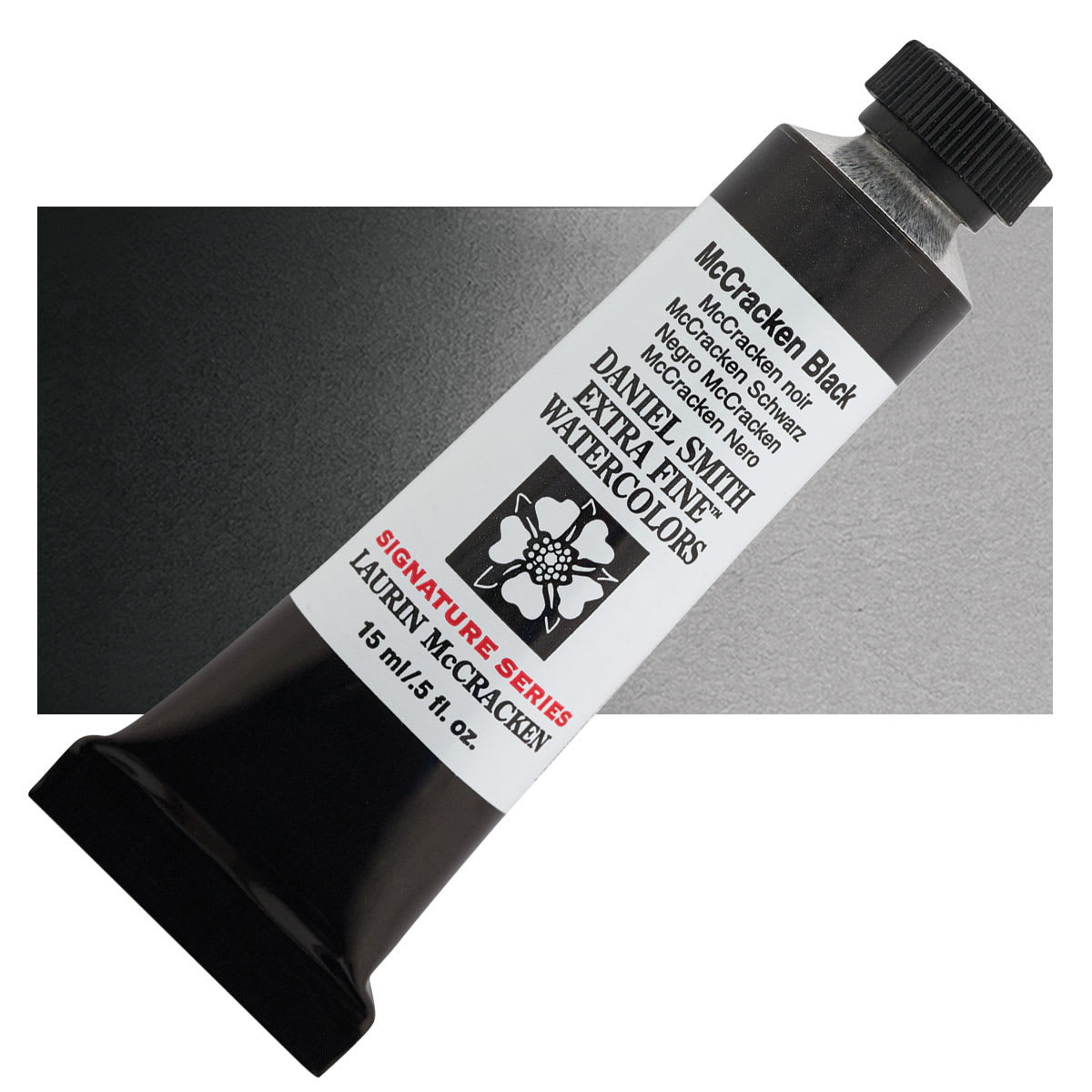
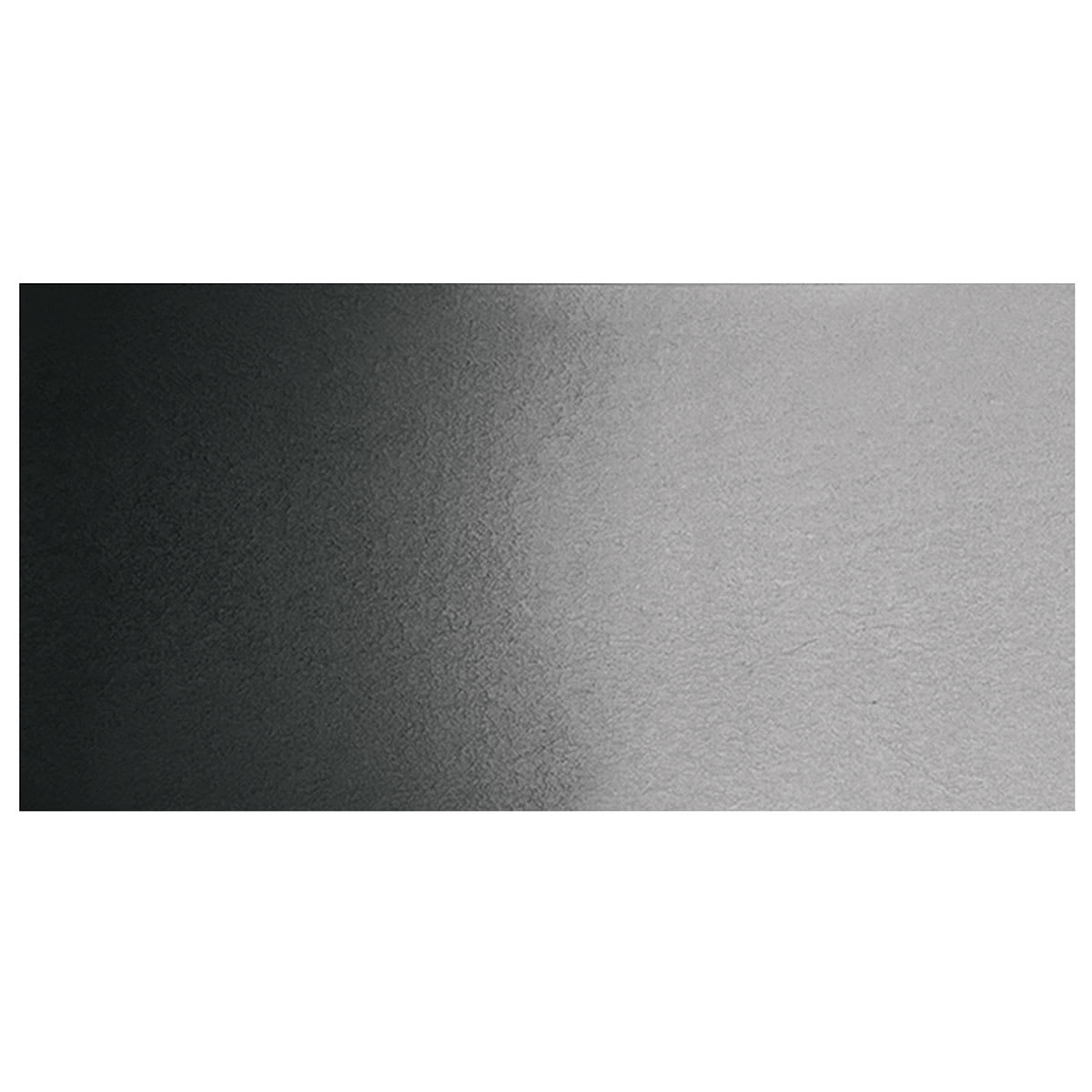
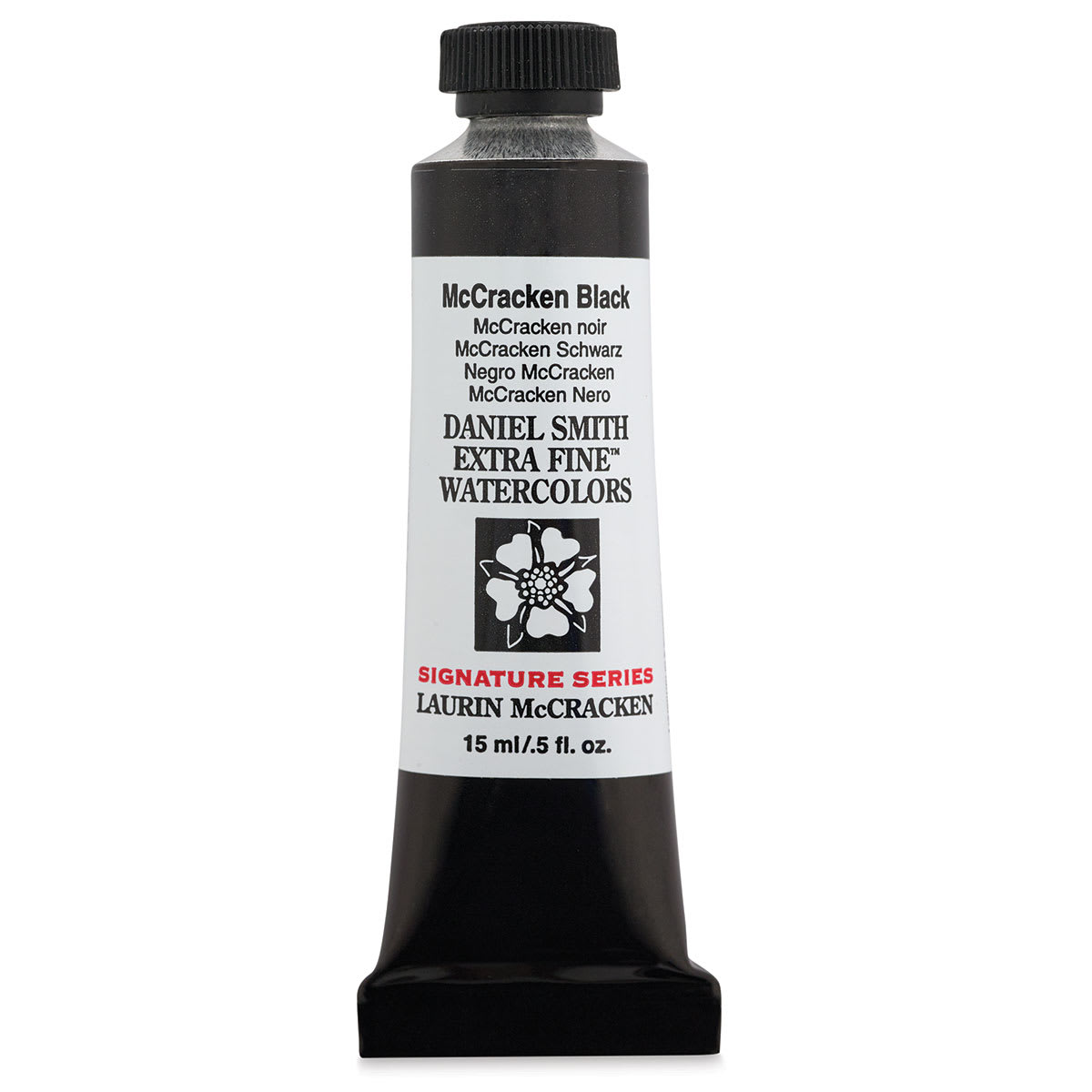
Daniel Smith Extra Fine Watercolor - McCracken Black, 15 ml Tube
Save For Later
My Store Pickup List
Please select a storeMy Wish Lists
My BlickU List(s)
My Quick Quotes
Product Details
- Description:
- Extra Fine Watercolor
- Color:
- McCracken Black
- Format:
- Tube
- Size:
- 15 ml (0.50 oz)
Reviews
Pigment Information
This color contains the following pigments:
PB27-Prussian Blue
PR101-Red Iron Oxide
PV23-Dioxazine Violet
PV19-Quinacridone Violet
PR177-Anthraquinone Red
PY150-Nickel Azo Yellow
PR149-Perylene Red
Pigment Name
PB27-Prussian Blue
Pigment Type
inorganic
Chemical Name
ferric ferrocyanide/iron(III)-hexacyanoferrate(II)
Chemical Formula
Fe7(CN)18(H2O)x or C6FeN6H4N
Properties
Prussian Blue is a semi-transparent, deep cyan-blue with a greenish undertone and a very high tinting strength unequaled by most pigments. It is similar to Phthalo Blue unless mixed with white, when it gives up intensity and becomes smoky. It can behave erratically and less reliably in oil and watercolor form depending on its manufacture. For permanent painting Phthalo Blue is considered a more reliable choice.
Permanence
Prussian Blue is lightfast and permanent in all techniques except for fresco. When mixed with Zinc White in watercolor or tempera form, it fades upon exposure to light and completely regains its chromatic strength in the dark. Modern manufacturing techniques have made this tendency less of an issue in recent years
History
"The first of the modern pigments," Prussian Blue is the first artificial pigment with a known history. It was discovered by accident in 1704 by the Berlin color maker Heinrich Diesbach, who was trying to create a pigment with a red hue by mixing iron sulfate and potash. The potash Diesbach purchased from a local laboratory had been contaminated by animal oil and blood during previous experimentation. The resulting mixture yielded a very pale red that changed to purple and then deep blue when he tried to concentrate it. Since previous blue pigments came from lapis lazuli, an expensive stone, Diesbach’s discovery was extremely important for artists of the time.
Pigment Name
PR101-Red Iron Oxide
Pigment Type
earth, synthetic
Chemical Name
iron oxides (synthetic), iron oxide, silica, alumina, lime, and magnesia or hydrated iron oxide
Chemical Formula
Fe2O2 or Fe2O3 x H2O
Properties
Red iron oxide varies in hue and transparency, depending on hydration and slight impurities. Indian Red is a slightly duller, deep brick hue with a bluish undertone. It is very dense and opaque, with excellent tinting strength and covering power. It is dependable when mixing with all other permanent pigments and yields good flesh tints when mixed with Zinc White. It is the synthetic version of PR102, which is a pigment made from earth reds, or natural red iron oxides, and the names applied to PR101 and PR102 often overlap. The synthetic red iron oxides have mostly replaced natural red iron oxides and are brighter, stronger, finer, and more permanent. Indian Red is the highest grade bluish shade. Light Red, English Red, and Venetian Red are yellowish shades. Mars Violet is a dull and subdued bluish or purplish oxide.
Permanence
Red iron oxide is very lightfast with excellent permanence.
History
Natural red iron oxide comes from the mineral ore hematite, called bloodstone by the ancient Greeks from the word hema, meaning blood. It is one of the oldest pigments, has been used by every major civilization, and was an important mineral for medieval alchemists. It was not widely used in artists' materials until the 17th century and was not produced in large quantities until the 18th century.
Pigment Name
PV23-Dioxazine Violet
Pigment Type
organic
Chemical Name
carbazole dioxazine
Chemical Formula
C34H22Cl2N4O2
Properties
Dioxazine Violet is transparent and has very high tinting strength. It is a staining pigment, very dark valued when it is used at full strength. Concentrated, it paints out nearly black, but it mixes with Titanium White to form bright, opaque tints of purple. PV23 produces slightly redder shades than PV37. Because the hue can vary with the conditions of preparation and grinding, it may be offered in red shade, blue shade, and so forth.
Permanence
Dioxazine Violet has good lightfastness. There may be some concern about it fading or shifting in color in tints and washes. Some artists have reported that PV37, a molecular variant, is more lightfast than PV23.
History
Two molecular variants of Dioxazine Violet, PV23 and PV37, are available. They have similar properties, but mix slightly differently.
Pigment Name
PV19-Quinacridone Violet
Pigment Type
organic synthetic, quinacridone
Chemical Formula
C20H12N2O2
Properties
Quinacridone Red is a high performance, transparent pigment with an average drying time and uneven dispersal. It is another name for Quinacridone Violet (PV19) and Quinacridone Red (PR192). Quinacridone pigments have relatively low tinting strength in general. For this reason, quinacridone colors are often expensive, because more pigment is required in the formulation.
Permanence
Quinacridone Violet has excellent lightfastness and is considered the most lightfast organic pigment in this shade range.
Pigment Name
PR177-Anthraquinone Red
Pigment Type
anthraquinone
Chemical Formula
C14H8O2
Properties
Anthraquinone Red is a magenta colored pigment that is transparent and moderately intense. It tends to fade in tints and is suitable for all media.
Permanence
Anthraquinone Red has good lightfastness and permanence in its masstone, while its tint lightfastness is moderate. Overall lightfastness and permanence varies by brand.
History
Anthraquinone pigments originated as textile vat dyes before being used as pigments. They became more popular with artists once it was discovered that careful preparation and grinding helped them to retain brilliance of color.
Pigment Name
PY150-Nickel Azo Yellow
Pigment Type
inorganic
Chemical Name
nickel azomethine yellow
Chemical Formula
C30H18Cl2N6NiO4
Properties
Nickel Azo Yellow is a transparent, moderately staining yellow pigment with high tinting strength. It is considered a good color match in botanical and landscape painting for natural gamboge (NY24), a historic yellow pigment with fair to poor lightfastness.
Permanence
Nickel azomethine yellow has excellent lightfastness.
History
Nickel azomethine yellow has been developed as an artist pigment becasue it is a close match for gamboge, a historic yellow.
Pigment Name
PR149-Perylene Red
Pigment Type
organic, anthraquinone
Chemical Formula
C40H26N2O6
Properties
Perylene Red is a moderately intense, semi-opaque, medium red pigment, appearing somewhere between a Cadmium Red and a Cadmium Deep Red hue. It has excellent brightness and tinting strength. Its partial transparency makes it useful as a glazing color.
Permanence
Perylene Red has good lightfastness and permanence. Its tints may darken after extended exposure to sunlight. It is not considered suitable for exterior use.
History
Perylenes have been used as vat dyes since 1912, but they were not manufactured and sold as pigments until 1957. For artists, they are a replacement for historic colors that were made with berries, and are significantly more lightfast.
Safety Data Sheet
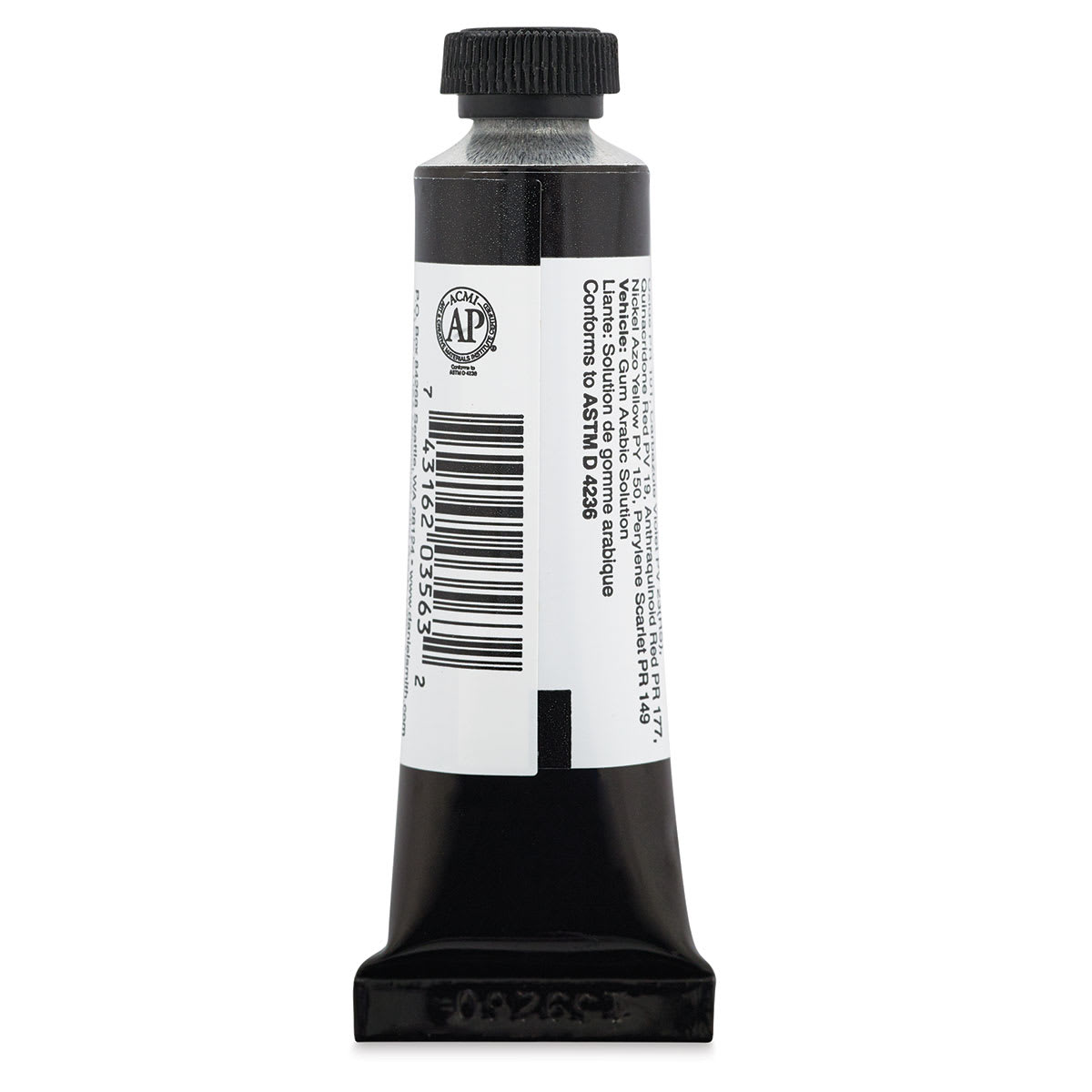
UPC Code: 743162035632