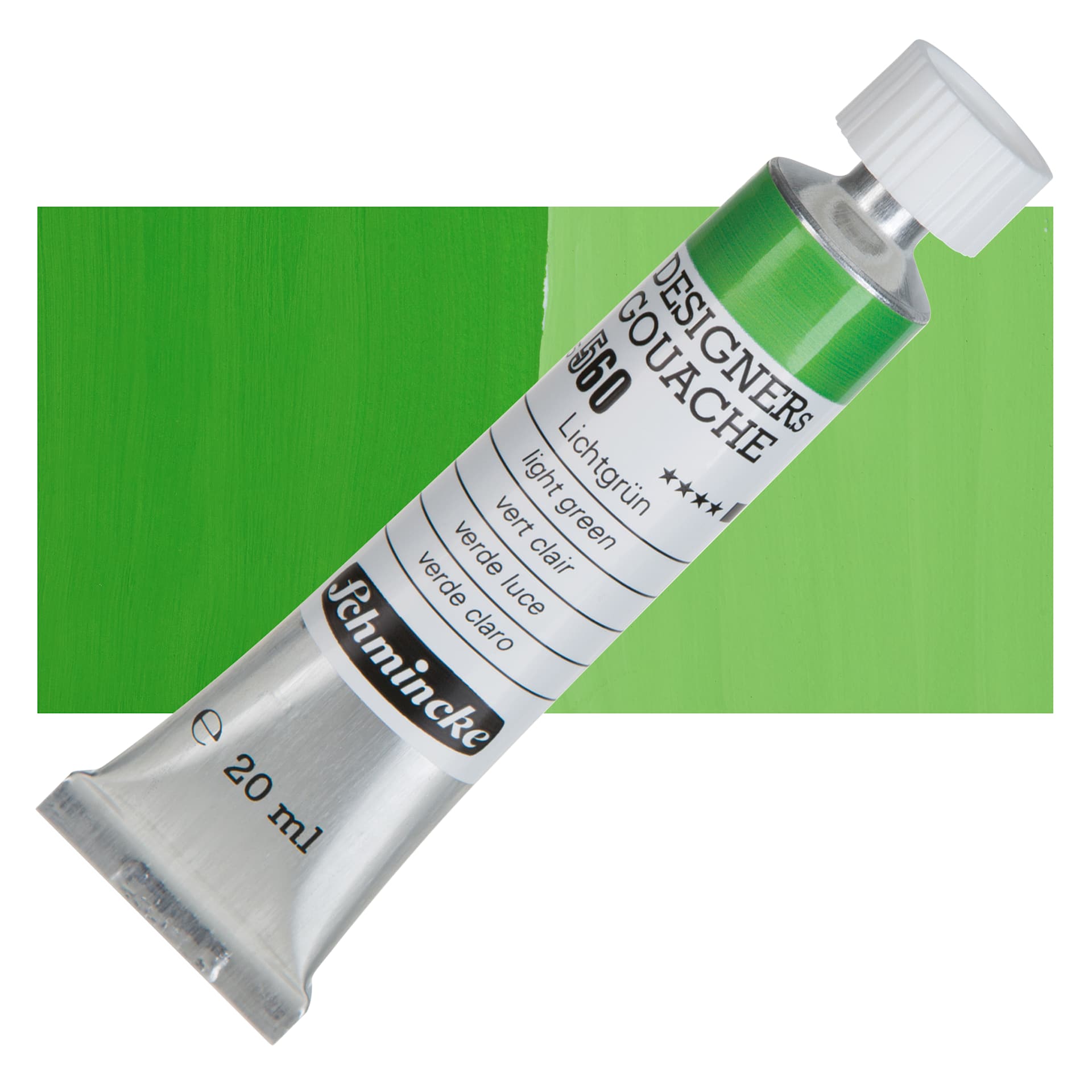
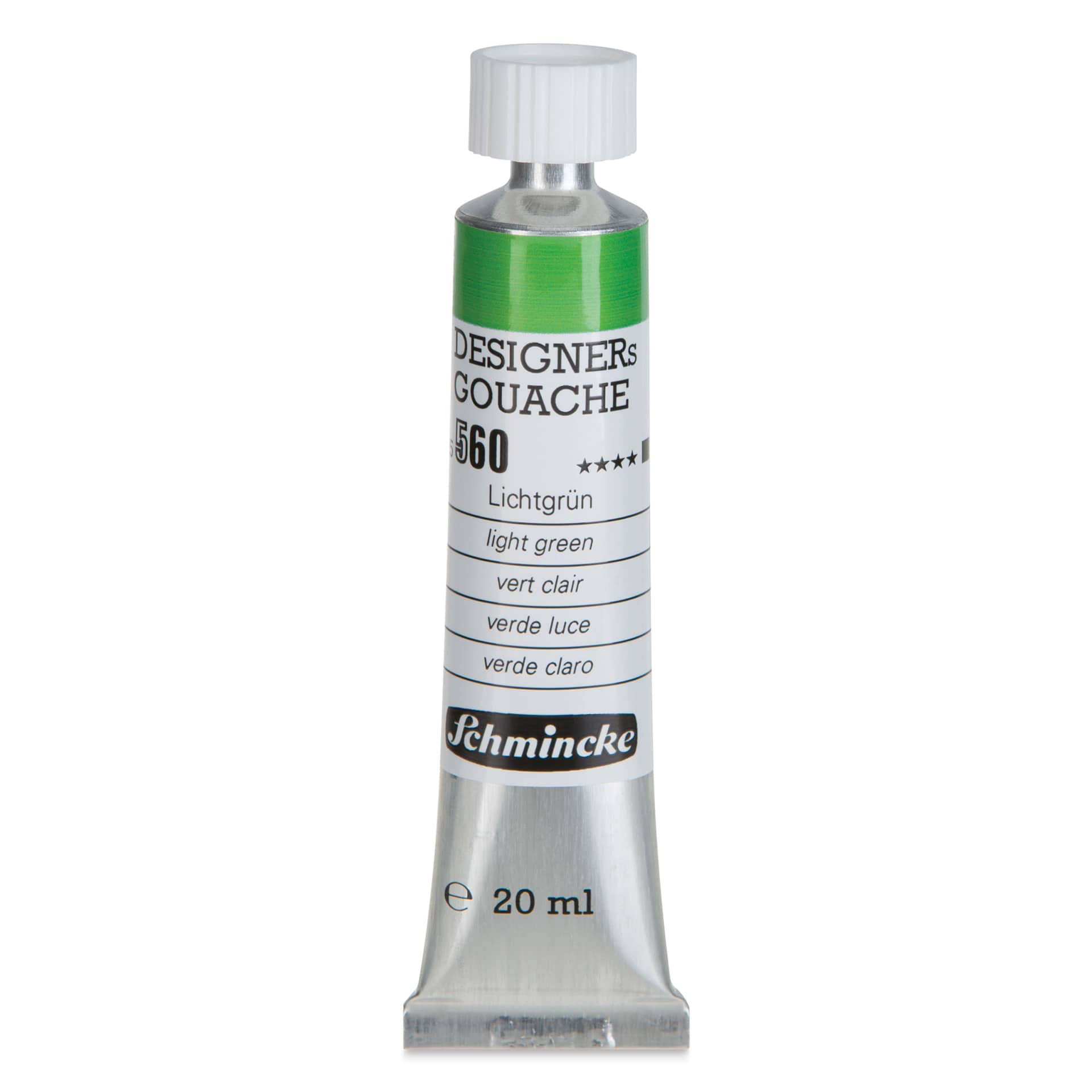
Schmincke Designers Gouache - Light Green, 20 ml Tube
Save For Later
My Store Pickup List
Please select a storeMy Wish Lists
My BlickU List(s)
My Quick Quotes
Product Details
- No.
- 25560
- Description:
- Designers Gouache
- Color:
- Light Green
- Format:
- Tube
- Size:
- 20 ml (0.68 oz)
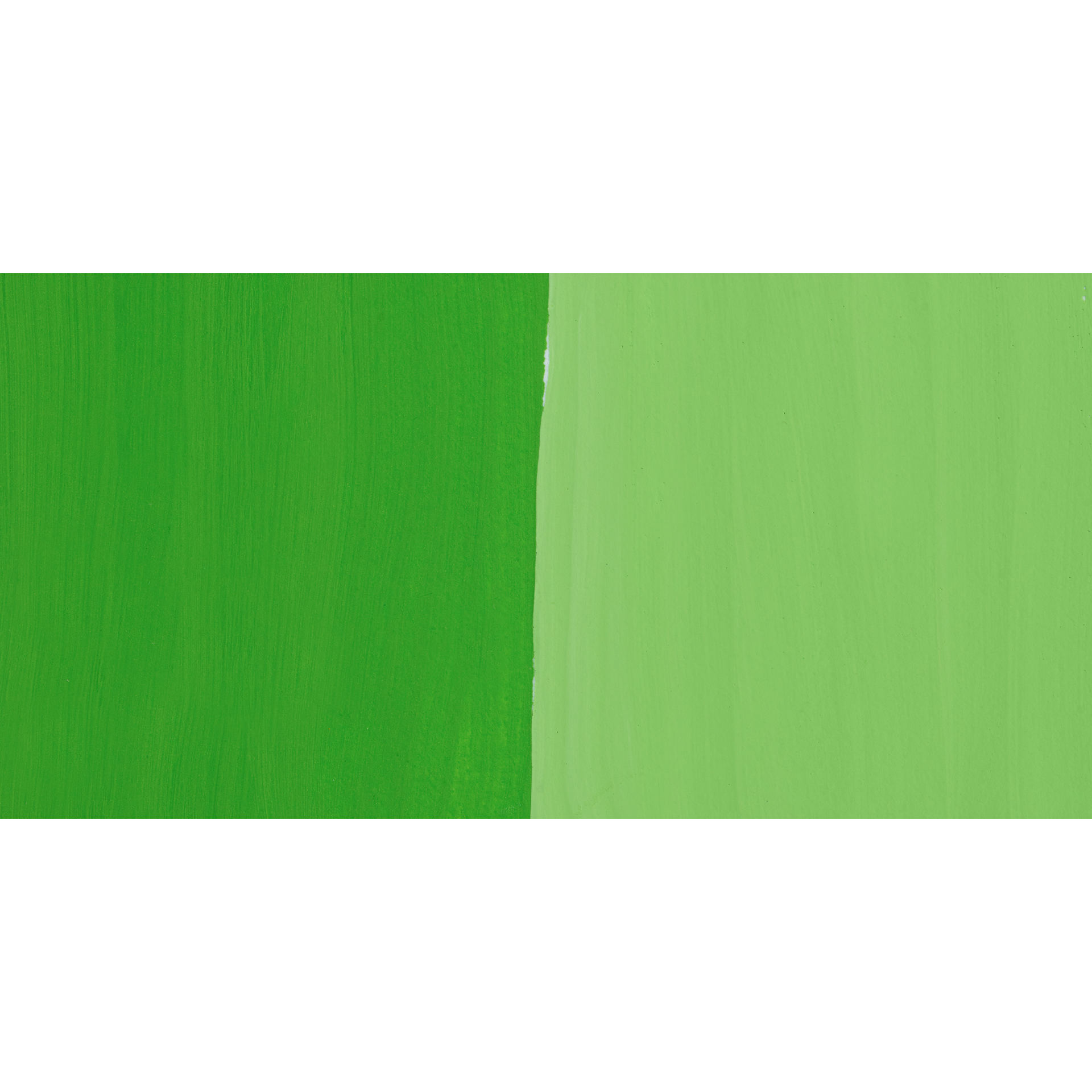
Colors on Monitors -
Due to differences in users’ monitors, the colors presented are an approximation of the true color.
Reviews
Pigment Information
This color contains the following pigments:
PW5-Lithopone
PY3-Hansa Yellow 10G
PY42-Yellow Iron Oxide
PG50-Cobalt Green
PG7-Phthalo Green
PY74-Hansa Yellow
Pigment Name
PW5-Lithopone
Pigment Type
inorganic
Chemical Name
coprecipitated zinc sulphide and barium sulphate
Chemical Formula
Zn + BaSO4
Properties
Lithopone is a low tinting strength, semi-transparent white pigment that is often used as a filler or extender in other colors, or as the base for laked pigments.
Permanence
Lithopone is absolutely permanent and lightfast.
History
Lithopone was discovered by G.F. de Doubet in 1850. It was developed commercially in the 1870s as a substitute or supplement for lead carbonate, to overcome the many shortcomings of white lead pigment, including toxicity, poor weathering, and darkening in the presence of sulfur compounds. It is used most often in interior paints and enamels. Its use as a white pigment has been superceeded in many applications by titanium dioxide.
Pigment Name
PY3-Hansa Yellow 10G
Pigment Type
organic, monoazo
Chemical Formula
C16H12CL2N4O2
Properties
This Hansa yellow is a transparent yellow. It has great brightness and tinting strength and its drying time ranges from average to slow. Hansa Yellow makes more intense tints and cleaner secondaries than Cadmium Yellows, especially when mixed with other organic or modern colors like Phthalo Blue and Green. Because they are more transparent, they have great value as glazing colors.
Permanence
This Hansa Yellow has fair to good permanence, particularly in the lighter shades.
Pigment Name
PY42-Yellow Iron Oxide
Chemical Name
iron(III)-oxide, hydrated
Chemical Formula
Fe2O3 • H2O
Properties
Yellow Ochre provides artists with earthtones from cream to brown. It has good hiding power, produces a quick drying paint, and can be safely mixed with other pigments. Its transparency varies widely from opaque shades to more transparent ones, which are valued for their use as glazes. If gypsum is present, Yellow Ochre is not suitable for frescoing. (See Brown Ochre, PY43.) PY42 is made from synthetic iron oxides. PY43 is made from natural iron oxide.
Permanence
Yellow Ochre has excellent permanence because ochres are some of the most permanent pigments available.
History
Ochre comes from the Greek word ochros, meaning pale yellow. It was one of the first pigments to be used by human beings, and evidence of its use has been found at 300,000 year old sites in France and the former Czechoslovakia.
Pigment Name
PG50-Cobalt Green
Pigment Type
inorganic
Chemical Name
cobalt titanium oxide
Chemical Formula
Co2TiO4
Properties
Cobalt Titanium Oxide is a low intensity color with a weak tinting strength, similar to Cobalt Blue. It has an average to fast drying time.
Permanence
Cobalt Green has excellent permanence and lightfastness.
History
Since ancient times, smalt blue has been used to color glass and ceramics. Cobalt salts, which give smalt its characteristic blue color, were identified in the 18th century. Techniques for manufacturing various cobalt salts, offering a range of blues and greens, were developed in the 19th century.
Pigment Name
PG7-Phthalo Green
Pigment Type
organic
Chemical Name
polychlorinated copper(II) phthalocyanine
Chemical Formula
C32H3Cl13CuN8 to C32HCl15CuN8 or C32H16CuN8Cl15 (PG7) or C32Br6Cl10CuN8 (PG36)
Properties
Phthalo Green is a transparent, cool, bright, high intensity color used in oil and acrylics. It comes from a Phthalocyanine Blue pigment where most of the hydrogen atoms have been replaced with chlorine, forming highly stable molecules. It has similar pigment properties and permanence to Phthalo Blue. It is slow drying and an excellent base color for mixing a range of bright greens. Phthalo Green is considered a very good alternative to Viridian because it is intense and mixes well and can be used to emphasize mineral colors in various tints. However, its tinting strength is very high, so it can overpower other colors. This pigment most closely resembles the discontinued and toxic Verdigris.
Permanence
Phthalo Greens are completely lightfast and resistant to alkali, acids, solvents, heat, and ultraviolet radiation. They are currently used in inks, coatings, and many plastics due to their stability and are considered a standard pigment in printing ink and the packaging industry.
Pigment Name
PY74-Hansa Yellow
Pigment Type
monoazo
Chemical Formula
C18H18N4O6
Properties
Pigment PY74 is one of the most commercially important pigments of the Hansa Yellow group, considered superior to many others in its class based on both tinting strength and lightfastness. Several PY74 grades with different particle sizes are available. Grades with finer particle size are more brilliant and transparent. Pigment PY74 ranges from reddish yellow to greenish yellow, with temperature shifts from cool to warm hues. It has high tinting strength and average to slow drying time.
Permanence
This Hansa Yellow has better lightfastness that other yellow monoazo pigments, particularly in the darker shades.
History
Hansa Yellows were first made in Germany just before WW1 from a series of synthetic dyestuffs called Pigment Yellow. They were intended to be a synthetic replacement for Cadmium Yellow.
Safety Data Sheet
UPC Code: 4012380023544