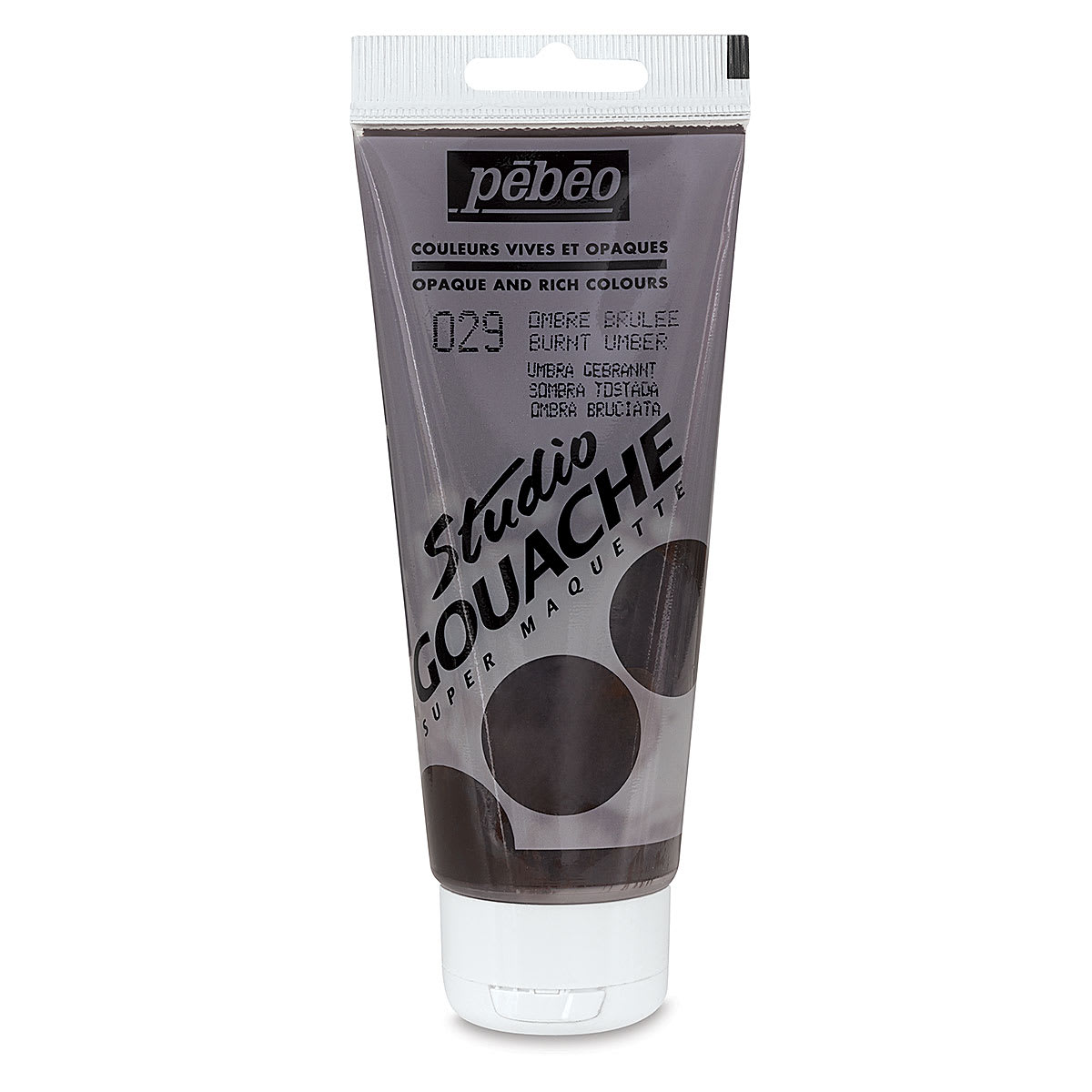
Pebeo Studio Gouache - Burnt Umber, 100 ml Tube

Save For Later
My Store Pickup List
Please select a storeMy Wish Lists
My BlickU List(s)
My Quick Quotes
Product Details
- Description:
- Studio Gouache
- Color:
- Burnt Umber
- Format:
- Tube
- Size:
- 100 ml (3.38 oz)
Colors on Monitors -
Due to differences in users’ monitors, the colors presented are an approximation of the true color.
Reviews
Pigment Information
This color contains the following pigments:
PBk11-Mars Black
PBr7-Burnt Umber
PBk9-Ivory Black
PR101-Red Iron Oxide
Pigment Name
PBk11-Mars Black
Pigment Type
earth
Chemical Name
iron oxides
Chemical Formula
FeO or Fe2O3
Properties
Mars Black is an opaque black with a strong and cool masstone, a slightly warm tint, and a warm brown undertone. It is not as black as Ivory Black, but it dries more quickly and has three times the tinting strength. Mars Black is normally the only black available in acrylic form and that is safe to over paint. It can be used in all media without reservation and is widely used as an alternative to Lamp Black and Ivory Black.
Permanence
Mars Black is very lightfast with excellent permanence.
History
The word Mars refers to the Roman god of iron and war. Mars Black was developed in the early 20th century from inorganic, synthetic iron oxide.
Pigment Name
PBr7-Burnt Umber
Pigment Type
earth
Chemical Name
iron oxides with manganese silicates or dioxide
Chemical Formula
Fe2O3,MnO2 or Fe2O3+MnO2+nH2O+Si+Al2O3
Properties
Burnt Umber is a more intense reddish brown pigment that results from heating the clay pigment Raw Umber. It has medium to excellent tinting strength and high opacity, and it is quick drying in oil form. Burnt Umber is somewhat more transparent than Raw Umber. It has excellent color properties and can create a variety of subtle, clear tints when mixed with white. It can tend towards chalkiness in dark mixes in oil form, but overall it mixes well with other colors. To create a black color in oil form, mix Burnt Umber with Phthalo Blue or Ultramarine. To achieve a similar color in watercolor form, mix it with Ultramarine or Payne's Gray.
Permanence
Burnt Umber has good permanence.
History
This pigment gets its name from the Latin word umbra, meaning shadow or shade. Its full name is listed as terra di ombra, meaning earth of shadow/shade, due to its original extraction from the area of Umbria, Italy. It has been used as a pigment since prehistoric times. Currently, the finest umber comes from Cyprus.
Pigment Name
PBk9-Ivory Black
Pigment Type
charred animal bone
Chemical Name
carbon + calcium phosphate
Chemical Formula
C + Ca3(PO4)2 or C x CaPO4
Properties
Ivory Black is a cool, semi-transparent blue-black with a slight brownish undertone and average tinting strength. It mixes well with any color, and creates a range of dull greens when mixed with yellow. It has good properties for use in oil, can be slow to dry in oil form, and should never be used in underpainting or frescoing. Ivory Black is denser than Lamp Black.
Permanence
Ivory Black is very lightfast and has good permanence, though it is considered the least permanent of the major black pigments.
History
Ivory Black is a carbon based black first named as Elephantium, and described in the 4th century BCE as produced by heating ivory scraps in clay pots to reduce the ivory or bone to charcoal. The deviation in names is because the more expensive varieties of this pigment were made by burning ivory, and the less expensive ones by burning animal bone. In the 19th century, the name Ivory Black was finally permitted to be applied to Carbon Black pigments made from bone. True Ivory Black is rare in modern times due to the protection of ivory, and the synthetic variety produced today was discovered in 1929. Bone Black is produced as an industrial pigment.
Pigment Name
PR101-Red Iron Oxide
Pigment Type
earth, synthetic
Chemical Name
iron oxides (synthetic), iron oxide, silica, alumina, lime, and magnesia or hydrated iron oxide
Chemical Formula
Fe2O2 or Fe2O3 x H2O
Properties
Red iron oxide varies in hue and transparency, depending on hydration and slight impurities. Indian Red is a slightly duller, deep brick hue with a bluish undertone. It is very dense and opaque, with excellent tinting strength and covering power. It is dependable when mixing with all other permanent pigments and yields good flesh tints when mixed with Zinc White. It is the synthetic version of PR102, which is a pigment made from earth reds, or natural red iron oxides, and the names applied to PR101 and PR102 often overlap. The synthetic red iron oxides have mostly replaced natural red iron oxides and are brighter, stronger, finer, and more permanent. Indian Red is the highest grade bluish shade. Light Red, English Red, and Venetian Red are yellowish shades. Mars Violet is a dull and subdued bluish or purplish oxide.
Permanence
Red iron oxide is very lightfast with excellent permanence.
History
Natural red iron oxide comes from the mineral ore hematite, called bloodstone by the ancient Greeks from the word hema, meaning blood. It is one of the oldest pigments, has been used by every major civilization, and was an important mineral for medieval alchemists. It was not widely used in artists' materials until the 17th century and was not produced in large quantities until the 18th century.
Safety Data Sheet
UPC Code: 3167862900293
ASIN #: B005IW0Y88