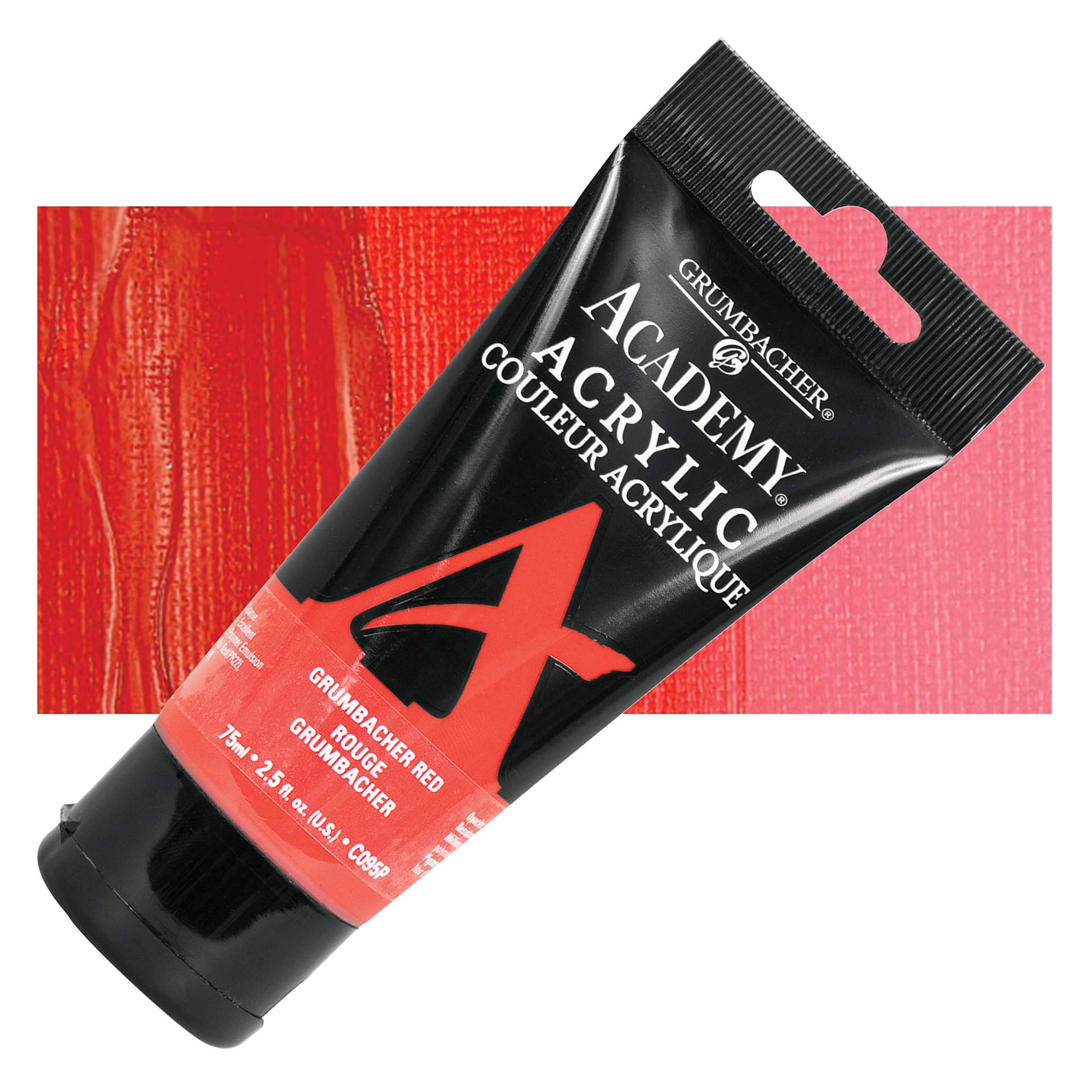
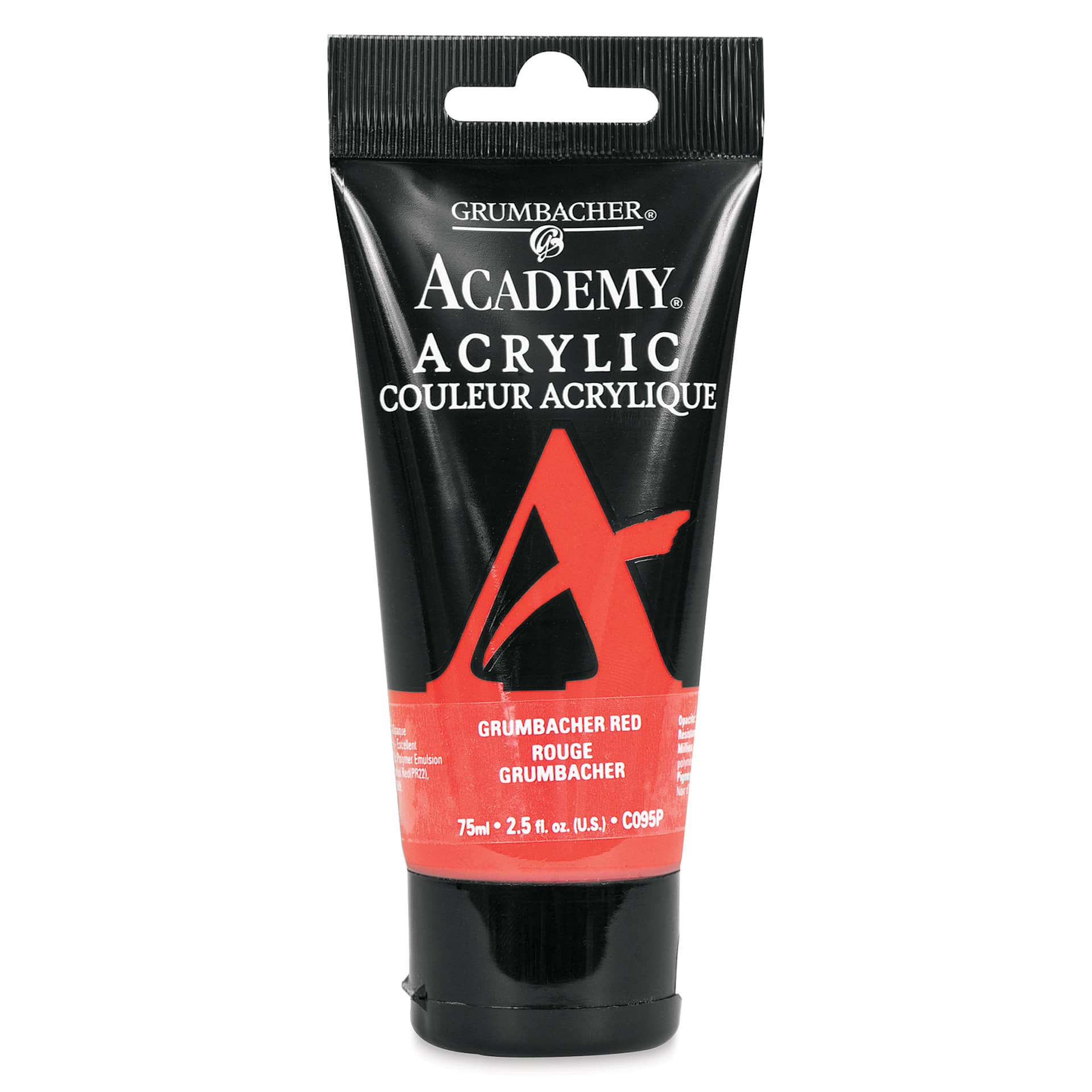
Grumbacher Academy Acrylic - Grumbacher Red, 75 ml tube

Save For Later
My Store Pickup List
Please select a storeMy Wish Lists
My BlickU List(s)
My Quick Quotes
Product Details
- No.
- c095
- Description:
- Academy Acrylic
- Color:
- Grumbacher Red
- Size:
- 75 ml (2.53 oz)
- Format:
- Tube
Colors on Monitors -
Due to differences in users’ monitors, the colors presented are an approximation of the true color.
Reviews
Pigment Information
This color contains the following pigments:
PR112-Naphthol Red AS-D
PBk9-Ivory Black
Pigment Name
PR112-Naphthol Red AS-D
Pigment Type
organic, monoazo
Chemical Formula
C24H16Cl3N3O2
Properties
This Naphthol Red is an intense scarlet red pigment that is heavily staining. It has an average drying time. It is semi-transparent and has relatively poor covering power.
Permanence
This Naphthol Red has been rated as having excellent lightfastness under ASTM testing, but other testing methods have demonstrated some tendancy for the color to fade with exposure to strong ultraviolet light. It has been considered a replacement for less lightfast naphthol reds such as PR3. Not suitable for exterior use.
Pigment Name
PBk9-Ivory Black
Pigment Type
charred animal bone
Chemical Name
carbon + calcium phosphate
Chemical Formula
C + Ca3(PO4)2 or C x CaPO4
Properties
Ivory Black is a cool, semi-transparent blue-black with a slight brownish undertone and average tinting strength. It mixes well with any color, and creates a range of dull greens when mixed with yellow. It has good properties for use in oil, can be slow to dry in oil form, and should never be used in underpainting or frescoing. Ivory Black is denser than Lamp Black.
Permanence
Ivory Black is very lightfast and has good permanence, though it is considered the least permanent of the major black pigments.
History
Ivory Black is a carbon based black first named as Elephantium, and described in the 4th century BCE as produced by heating ivory scraps in clay pots to reduce the ivory or bone to charcoal. The deviation in names is because the more expensive varieties of this pigment were made by burning ivory, and the less expensive ones by burning animal bone. In the 19th century, the name Ivory Black was finally permitted to be applied to Carbon Black pigments made from bone. True Ivory Black is rare in modern times due to the protection of ivory, and the synthetic variety produced today was discovered in 1929. Bone Black is produced as an industrial pigment.
Safety Data Sheet
UPC Code: 014173374127
ASIN #: B009OR1V8A