Primers and Gessoes


Shop All Primers and Gessoes
81 products
Displays products in a grid view
Displays products in a detail view
Shop All Primers and Gessoes
81 products
+ 17 Options
Liquitex Acrylic Gessos
+ 17 Options
Item #: 00618
A ready-mixed painting ground, Liquitex Acrylic Gessos prime surfaces and add the right level of tooth for optimum color stability, adhesion, and abso...
+ 4 Options
Golden Acrylic Gesso
+ 4 Options
Item #: 00628
Golden Acrylic Gesso is a ready-to-use liquid ground formulated for the use of acrylics on any commonly used painting surface. It’s flexible and can b...
+ 5 Options
Blick Artists' Acrylic Gesso
+ 5 Options
Item #: 00691
Our own exclusive artists' grade gesso offers good opacity, tooth, adhesion, and water-resistance at an economical Blick price.
+ 7 Options
Utrecht Artists' Acrylic Gesso
+ 7 Options
Item #: 02032
Utrecht Artists' Acrylic Gesso is a professional-quality, universal acrylic ground. A thick, flexible formula with medium viscosity offers excellent c...
+ 3 Options
Blickrylic Gesso
+ 3 Options
Item #: 00711
Blickrylic Gesso is non-toxic, and can be mixed with other brands of acrylics. Apply it as a ground to any surface to improve adherance of Blickrylic ...
+ 2 Options
Utrecht Professional Acrylic Gesso
+ 2 Options
Item #: 02033
Utrecht Professional Gesso is a museum-quality, universal acrylic ground. An ultra-thick, concentrated, high-viscosity formula provides optimal whiten...
Flexbond for Worbla Adhesive
Item #: 23942
Perfect for cosplay creations or around the house, this multi-use glue and primer works with all types of foam, fabric, felt, and more. It dries smoot...
+ 3 Options
Gamblin Oil Painting Ground
+ 3 Options
Item #: 01536
Prepare a cotton or linen canvas that is stiffer than with an acrylic gesso, yet more flexible than with a traditional oil primer. The binder in Gambl...
+ 12 Options
Golden Pumice Gel Mediums
+ 12 Options
Item #: 00628
Used for making textures or grounds for drawing, Golden Pumice Gel Mediums dry to a hard film. Blend Pumice Gels with Golden acrylic colors, or mix in...
+ 2 Options
Utrecht Studio Series Acrylic Gesso
+ 2 Options
Item #: 02031
Utrecht Studio Series Gesso is an economical acrylic ground for high-volume use with acrylics and oils. A pourable, light-bodied formula with low visc...
+ 2 Options
Gamblin PVA Sizing
+ 2 Options
Item #: 08924
PVA (Poly Vinyl Acetate) is a contemporary size for fabric support. On linen and cotton canvas, it prevents the fabric from absorbing atmospheric mois...
Utrecht Rabbit Skin Glue
Item #: 08943
Utrecht Rabbit Skin Glue is a top-quality, traditional canvas and panel sizing that exhibits excellent adhesion and barrier properties. Handcrafted in...
+ 4 Options
Liquitex Basics Acrylic Gesso
+ 4 Options
Item #: 00716
Produces a smooth, absorbent, finely textured ground for painting on most porous surfaces, such as canvas, paper, fabric, wood, or plaster. No thinnin...
+ 3 Options
Golden Pastel Ground
+ 3 Options
Item #: 00627
Apply this translucent acrylic ground to paper, board, or any surface you wish. It provides a rough, "gritty" tooth, making it perfect for use with pa...
+ 4 Options
Golden Black Gesso
+ 4 Options
Item #: 00628
Golden Black Gesso is a ready-to-use liquid ground formulated to add “tooth” to canvas, board, and other commonly used painting surfaces. Apply it in ...
Blick Studio Gesso
Item #: 00682
Prepare canvas, linen, and board with bright white, non-permeable Dick Blick Studio Gesso - the perfect primer for oil and acrylic painting. It covers...
+ 39 Options
Matisse Background Colors Acrylic Paints
+ 39 Options
Item #: 09402
Create the perfect low-tooth base for a variety of media. Matisse Background Colors are made with a combination of high-grade acrylic paint and profes...
+ 4 Options
Golden Absorbent Ground
+ 4 Options
Item #: 00627
Acrylic liquid dries to a porous, paper-like surface with high absorbency. Applied over gessoed canvas for staining techniques and watermedia applicat...
+ 2 Options
Blick Professional Acrylic Gesso
+ 2 Options
Item #: 00691
The frugal professional's best choice! Blick Professional Acrylic Gesso offers maximum opacity, tooth, adhesion, and water-resistance, plus the highes...
+ 30 Options
Michael Harding Non-Absorbent Acrylic Primers
+ 30 Options
Item #: 08952
Stop oil colors from looking dull, flat, and muted with Michael Harding Non-Absorbent Acrylic Primer. This specially formulated primer creates a non-a...
+ 3 Options
Tight'N'Up Liquid Canvas Retensioner
+ 3 Options
Item #: 08920
Tight'N'Up Liquid Canvas Retensioner is the perfect solution to most canvas tension problems. It instantly and safely tightens well-stretched canvas a...
+ 21 Options
Holbein Acryla Colored Gesso
+ 21 Options
Item #: 02009
Holbein has created this unique and versatile product. It can be used as a traditional underpainting on all surfaces. It also acts as an extremely opa...
+ 21 Options
Art Spectrum Pastel and Multimedia Primer
+ 21 Options
Item #: 22999
Art Spectrum Pastel and Multimedia Primer colors are permanent and non-toxic. They provide a fine, positive tooth to hold extra color on your work. Ap...
+ 4 Options
Golden Sandable Hard Gesso
+ 4 Options
Item #: 00628
Golden Sandable Hard Gesso is formulated with 100% acrylic dispersion polymer. Sand it to create surfaces that are smoother and more even than those c...
+ 4 Options
R&F Encaustic Gesso
+ 4 Options
Item #: 03503
R&F Encaustic Gesso is a waterbased, non-toxic ground for encaustic painting. It is non-yellowing, flexible, non-cracking and sandable to a smooth, cl...
+ 3 Options
Golden GAC 400 Fabric Stiffener
+ 3 Options
Item #: 00628
Harden, sculpt, and shape fabrics with Golden GAC 400 Fabric Stiffener. An alternative to rabbit skin glue, this medium can be used to prime and reduc...
+ 6 Options
Winsor & Newton Artists' Acrylic Gesso
+ 6 Options
Item #: 03504
Use Winsor & Newton Artists' Acrylic Gesso to prime surfaces and provide "tooth" for good adhesion of acrylics, oils, and alkyds. Available in White o...
Williamsburg Rabbit Skin Glue
Item #: 03507
This 100% genuine rabbit skin glue comes in a fine crystallized powder form.
+ 2 Options
Williamsburg Titanium Oil Ground
+ 2 Options
Item #: 03507
Containing no zinc or alkyd, Williamsburg Titanium Oil Ground is made with titanium dioxide and marble dust ground in 100% alkali-refined linseed oil....
+ 3 Options
Bob Ross Gessos
+ 3 Options
Item #: 00455
This water-based primer should be applied very thinly with a foam applicator, not a brush, and allowed to dry completely before you begin painting in ...


Featured Article
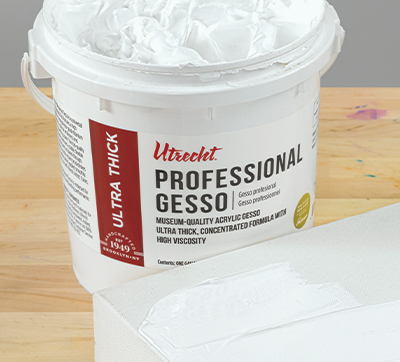
The Evolution of Gesso
Most people recognize the Italian loan-word “Gesso” as both a noun and verb referring to a water-based priming for artistic painting, but not many know the origin of the term, how its meaning has changed, or the story of how the founders of Utrecht Art Supplies invented an Acrylic-based Gesso that transformed in-studio preparation of painting supports from a risky, two-week ordeal into a fast, safe way to make almost any surface into a universal painting support.
More Primers and Gessoes Articles
Frequently Asked Questions
Featured Lesson Plans

Architectural Letters
In this lesson plan, students design and construct a 3-dimensional letter using one of their initials. The surface can be decorated with descriptive words and images that are personally meaningful and unique to the student's identity. Instead of wet, messy adhesive, this process uses paper packing tape to create papier mâché. This tape is inexpensive, easy, and tidy to use, and the finished letters are hard and durable.
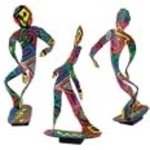
Figures in Motion
Inspired by the painting and sculpture of Edgar Degas, this lesson allows students to explore proportion and describe movement using a flat, paper doll-type figure that can be manipulated when wet and is rigid when dry.

Have a Ball! with distorted self-portraits
"Observing and reproducing the distortion caused by a concave reflection is the topic of this lesson plan, as students make self-portraits inspired by M.C. Escher's “Hand with Reflecting Globe.” The canvas is a vinyl bouncing ball. Elementary ages can be challenged to create a continuous painting — with no beginning or end — then “Have a Ball!” playing with their own artwork."
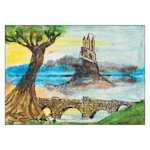
Abstract Pressed Landscape
Easily teach the concept of a horizon line while making a beautiful symmetrical pressed landscape. Fold paper in half, then transfer paints and pigments in a method similar to the Rorschach prints. After printing, add detail using markers. The process is customizable based on age. Just press for younger students, or add sophisticated details at older ages.

Assemblage Art
In this particular lesson plan, students will look closely at the work of Louise Nevelson, known for her abstract sculptures made from cast-off pieces of wood — actual street “throwaways” — uniformly coated with black or white spray paint. Students will create their own assemblages from wood pieces and other cast-off objects on a panel.
Featured Videos
Understanding the Difference Between Primer and Ground
What Is Canvas Sizing and Why Use It?


Featured Brands


