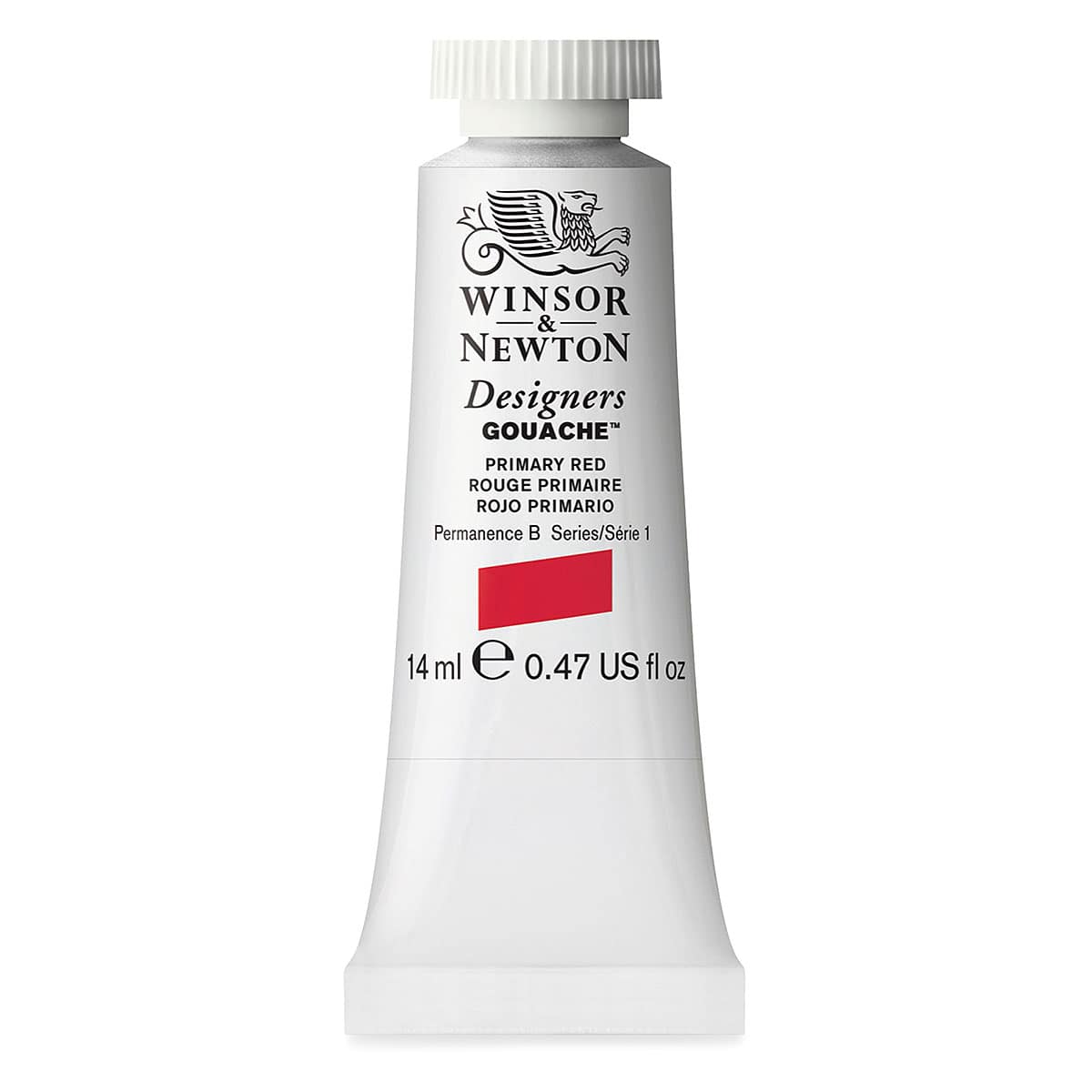
Winsor & Newton Designers Gouache - Primary Red, 14 ml tube


Save For Later
My Store Pickup List
Please select a storeMy Wish Lists
My BlickU List(s)
My Quick Quotes
Product Details
- No.
- 524
- Description:
- Designers Gouache
- Color:
- Primary Red
- Series:
- 1
- Format:
- Tube
- Size:
- 14 ml (0.47 oz)
Shipping Note - Due to manufacturer distribution restrictions, Winsor & Newton products cannot be shipped to addresses outside of North America.
Colors on Monitors -
Due to differences in users’ monitors, the colors presented are an approximation of the true color.
Reviews
Pigment Information
This color contains the following pigments:
PR170-Naphthol Red
Pigment Name
PR170-Naphthol Red
Pigment Type
organic, naphthol AS
Chemical Formula
C26H22N4O4
Properties
Pigment PR170 is a bright deep red with bluish undertones. It has an average drying time. It has two crystaline forms that differ significantly in opacity. The more transparent form (F5RK) tends to be more bluish and is less lightfast.
Permanence
The lightfastness and weatherfastness of Pigment PR170 varies, depending on the application and the crystaline form. The opaque form (F3RK) has very good lightfastness, and is more weather resistant. The transparent form (F5RK) has lightfastness that is considered acceptable in pure applications, but it fades more in tints. Neither form is considered suitable for exterior use.
History
Naphthol pigments are actually dyes that are "laked" to form pigments. First developed by the German chemical company Hoechst A.G. before World War I, their use in artist paints began in the 1920s. Pigment Red PR170 is a Naphthol AS pigment, chemically related to the diarylide yellow pigments. The Naphthol AS pigments comprise a range of reds. They are used in plastics, textiles, and printing inks.
Safety Data Sheet
UPC Code: 50958054
ASIN #: B000OL5KLE