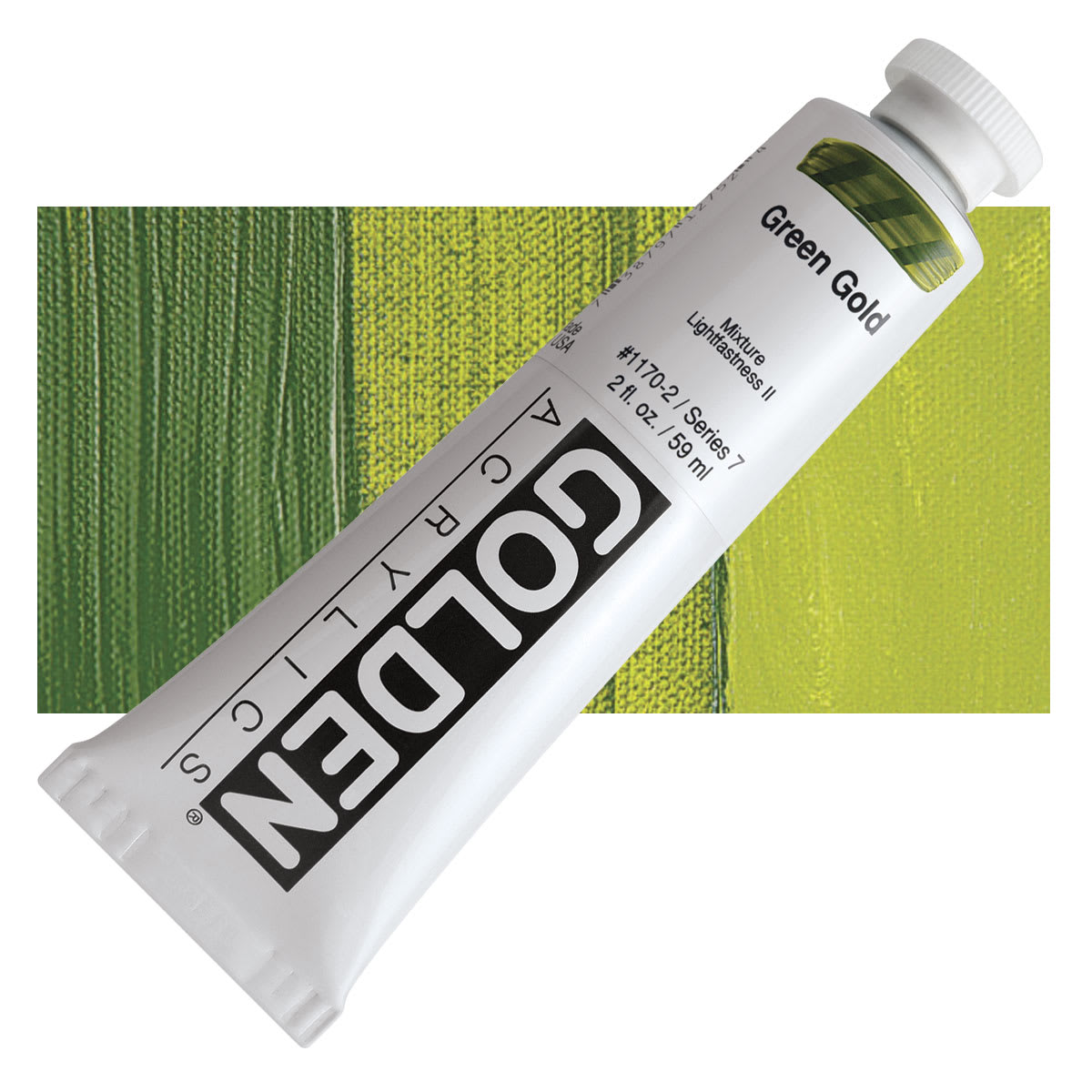
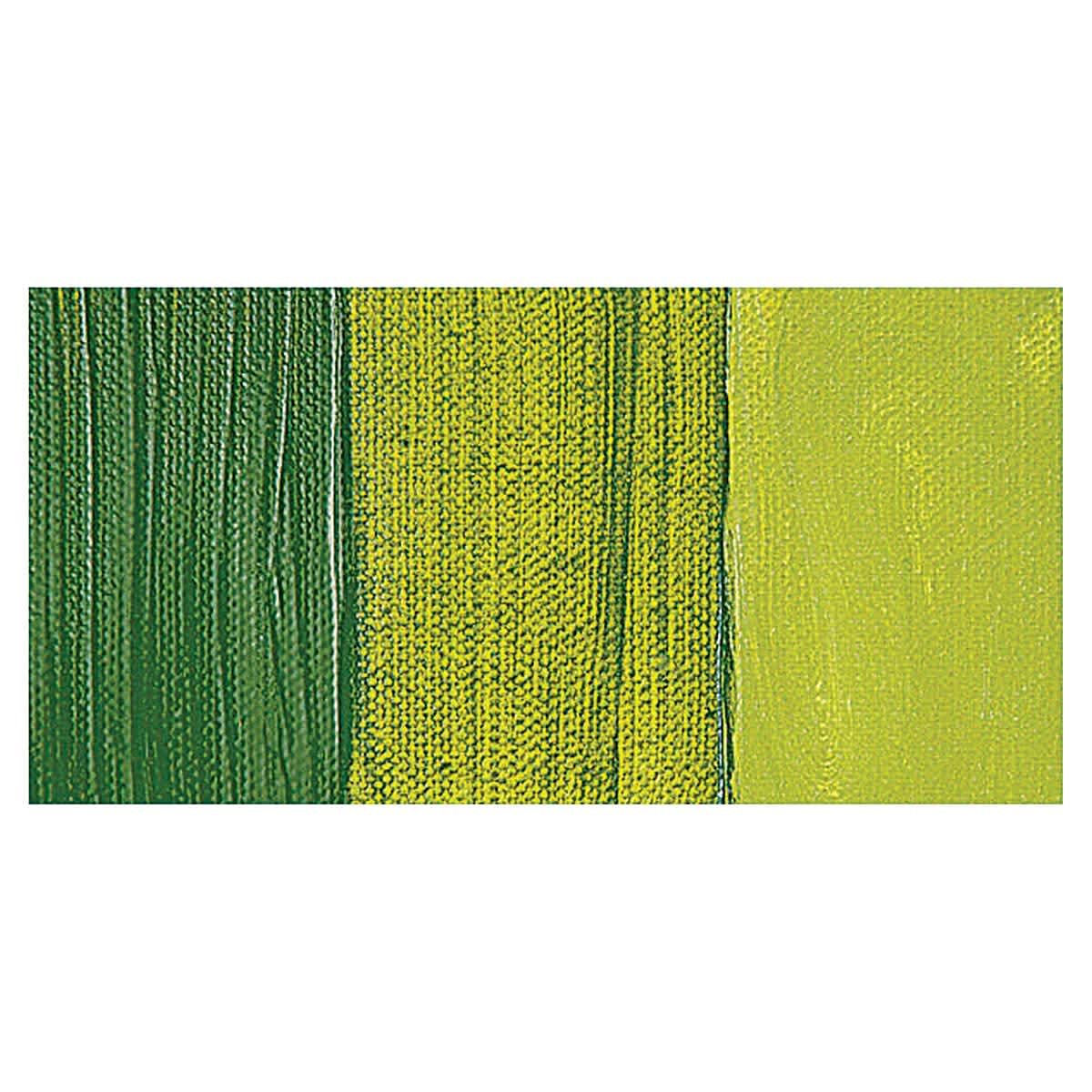
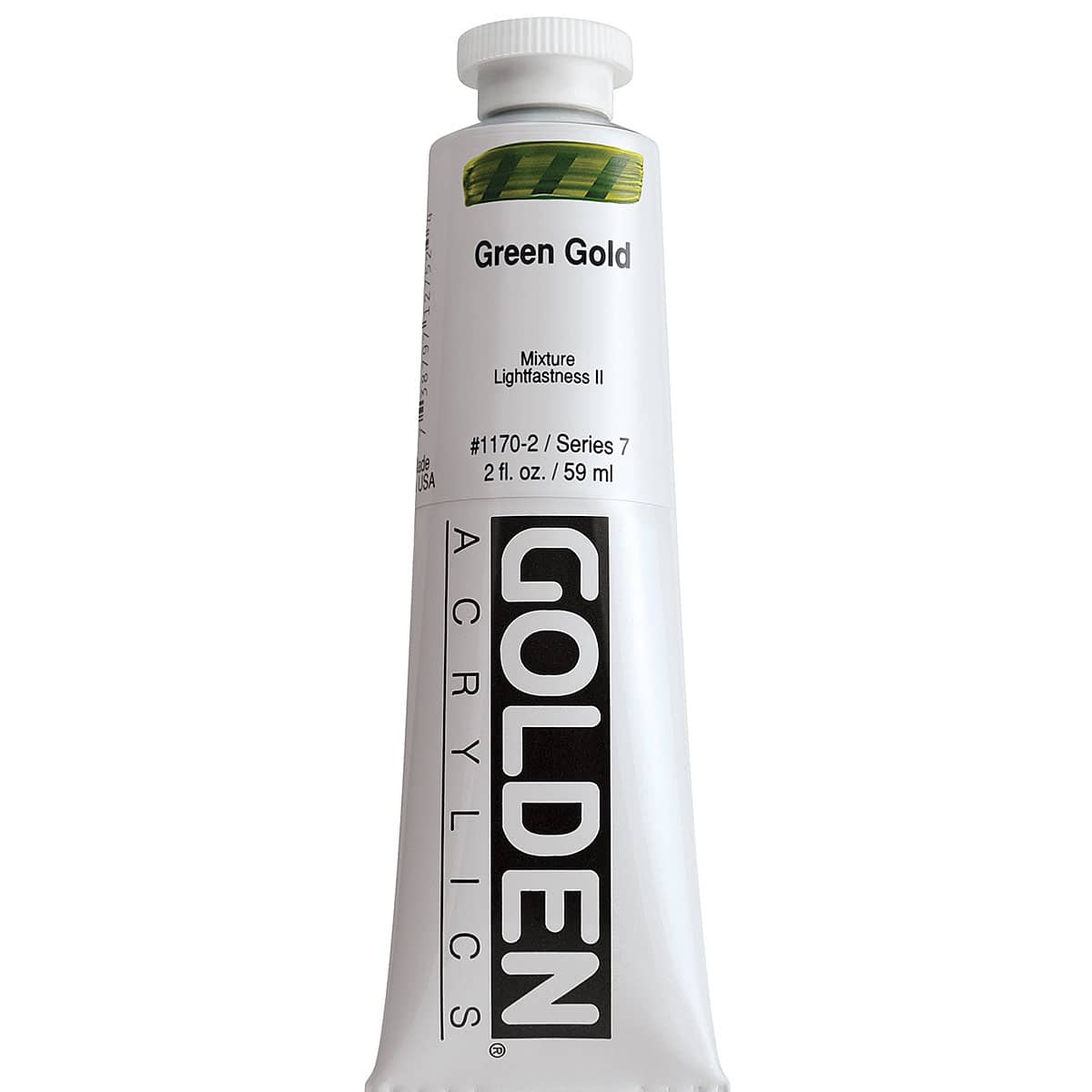
Golden Heavy Body Artist Acrylics - Green Gold, 2 oz Tube
Save For Later
My Store Pickup List
Please select a storeMy Wish Lists
My BlickU List(s)
My Quick Quotes
Product Details
- No.
- 1170
- Description:
- Heavy Body Acrylic
- Color:
- Green Gold
- Size:
- 59 ml (2 oz)
- Format:
- Tube
- Series:
- 7
Colors on Monitors -
Due to differences in users’ monitors, the colors presented are an approximation of the true color.
Reviews
Pigment Information
This color contains the following pigments:
PY150-Nickel Azo Yellow
PG36-Phthalo Green
PY175-Benzimidazolone Yellow
Pigment Name
PY150-Nickel Azo Yellow
Pigment Type
inorganic
Chemical Name
nickel azomethine yellow
Chemical Formula
C30H18Cl2N6NiO4
Properties
Nickel Azo Yellow is a transparent, moderately staining yellow pigment with high tinting strength. It is considered a good color match in botanical and landscape painting for natural gamboge (NY24), a historic yellow pigment with fair to poor lightfastness.
Permanence
Nickel azomethine yellow has excellent lightfastness.
History
Nickel azomethine yellow has been developed as an artist pigment becasue it is a close match for gamboge, a historic yellow.
Pigment Name
PG36-Phthalo Green
Pigment Type
organic
Chemical Name
polybromopolychlorinated copper(II) phthalocyanine
Chemical Formula
C32H3Cl13CuN8 to C32HCl15CuN8 or C32H16CuN8Cl15 (PG7) or C32Br6Cl10CuN8 (PG36)
Properties
Phthalo Green is a transparent, cool, bright, high intensity color used in oil and acrylics. It comes from a Phthalocyanine Blue pigment where most of the hydrogen atoms have been replaced with chlorine, forming highly stable molecules. Pigment PG36 differs from PG7 in that a portion of the chlorine atoms are replaced with bromine atoms, which are reactively similar, but cause a yellow shift that is especially noticeable in mixtures. Phthalo Green has similar pigment properties and permanence to Phthalo Blue. It is slow drying and an excellent base color for mixing a range of bright greens. Phthalo Green is considered a very good alternative to Viridian because it is intense and mixes well and can be used to emphasize mineral colors in various tints. However, its tinting strength is very high, so it can overpower other colors. This pigment most closely resembles the discontinued and toxic Verdigris.
Permanence
Phthalo Greens are completely lightfast and resistant to alkali, acids, solvents, heat, and ultraviolet radiation. They are currently used in inks, coatings, and many plastics due to their stability and are considered a standard pigment in printing ink and the packaging industry.
History
This bright blue-green was developed in 1935 and has been in use since 1938.
Pigment Name
PY175-Benzimidazolone Yellow
Pigment Type
monoazo
Properties
Benzimidazolone Yellow is a bright yellow, semi-transparent pigment, slightly greenish, with dull tints and an average drying time.
Permanence
Benzimidazolone Yellow has excellent lightfastness.
History
The benzimidazolone group of pigments was developed and patented in 1960 by Hoechst A.G., a German chemical manufacturer that was a forerunner of the pharmaceutical company Aventis.
Safety Data Sheet
UPC Code: 738797117020
ASIN #: B0006VBQBA