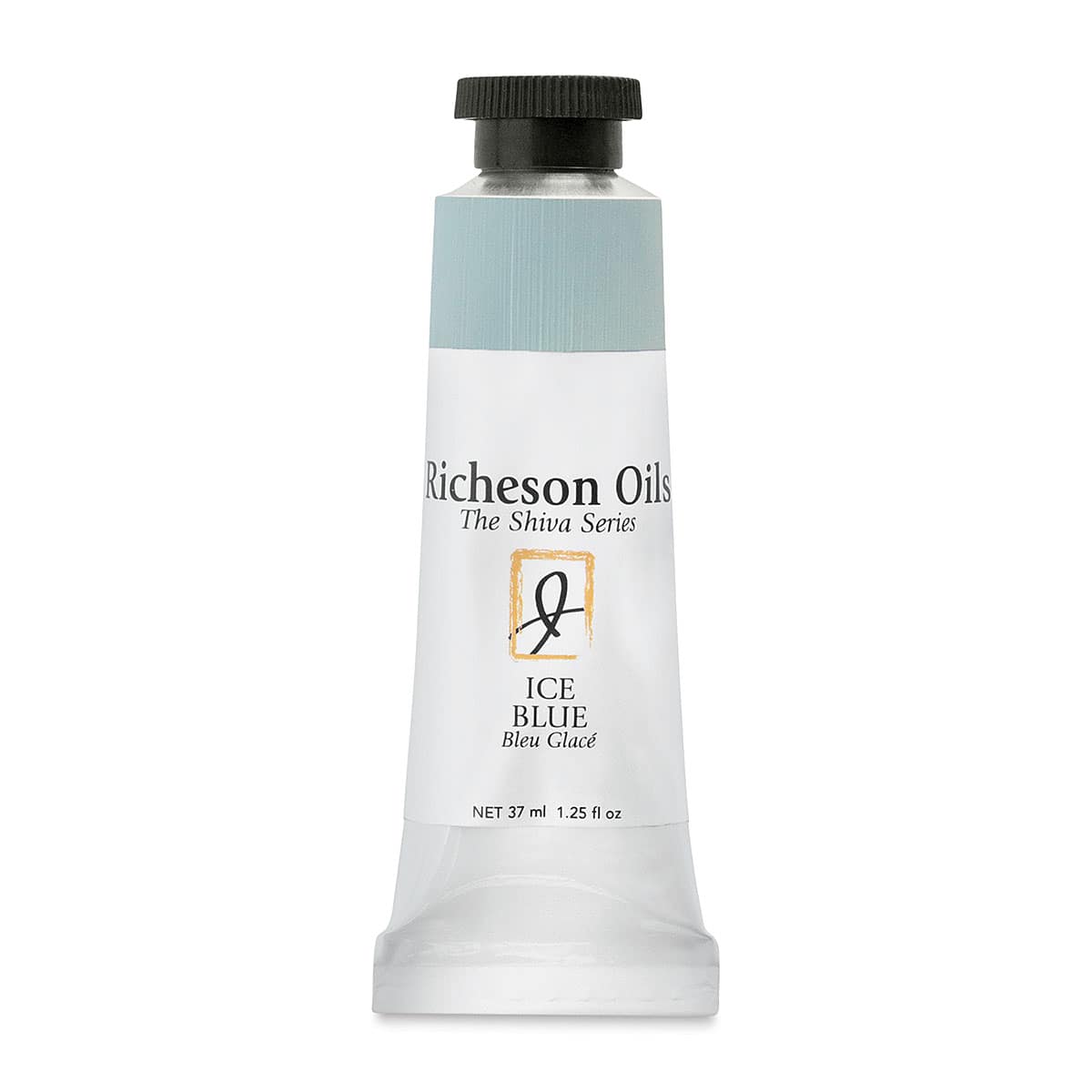
Shiva Signature Artist Oil Color - Ice Blue, 1.25 oz Tube


Save For Later
My Store Pickup List
Please select a storeMy Wish Lists
My BlickU List(s)
My Quick Quotes
Product Details
- No.
- 120036
- Description:
- Artist Oil Paint
- Color:
- Ice Blue
- Size:
- 37 ml (1.25 oz)
- Format:
- Tube
- Series:
- 2
Colors on Monitors -
Due to differences in users’ monitors, the colors presented are an approximation of the true color.
Reviews
Pigment Information
This color contains the following pigments:
PB27-Prussian Blue
PW6-Titanium White
PBr7-Burnt Umber
Pigment Name
PB27-Prussian Blue
Pigment Type
inorganic
Chemical Name
ferric ferrocyanide/iron(III)-hexacyanoferrate(II)
Chemical Formula
Fe7(CN)18(H2O)x or C6FeN6H4N
Properties
Prussian Blue is a semi-transparent, deep cyan-blue with a greenish undertone and a very high tinting strength unequaled by most pigments. It is similar to Phthalo Blue unless mixed with white, when it gives up intensity and becomes smoky. It can behave erratically and less reliably in oil and watercolor form depending on its manufacture. For permanent painting Phthalo Blue is considered a more reliable choice.
Permanence
Prussian Blue is lightfast and permanent in all techniques except for fresco. When mixed with Zinc White in watercolor or tempera form, it fades upon exposure to light and completely regains its chromatic strength in the dark. Modern manufacturing techniques have made this tendency less of an issue in recent years
History
"The first of the modern pigments," Prussian Blue is the first artificial pigment with a known history. It was discovered by accident in 1704 by the Berlin color maker Heinrich Diesbach, who was trying to create a pigment with a red hue by mixing iron sulfate and potash. The potash Diesbach purchased from a local laboratory had been contaminated by animal oil and blood during previous experimentation. The resulting mixture yielded a very pale red that changed to purple and then deep blue when he tried to concentrate it. Since previous blue pigments came from lapis lazuli, an expensive stone, Diesbach’s discovery was extremely important for artists of the time.
Pigment Name
PW6-Titanium White
Pigment Type
inorganic
Chemical Name
titanium dioxide
Chemical Formula
TiO2
Properties
Titanium White is the most brilliant of the white pigments. It is considered an all purpose oil color useful in all techniques and the best all around white. Its masstone is neither warm nor cool, placing it somewhere between Lead White and Zinc White. It is less prone to cracking and yellowing than Lead White, but it still yellows easily. Titanium White dries slowly in oil form, more slowly than Lead White but more quickly than Zinc White. It is opaque in oil and acrylic forms and semi-opaque in watercolor form. This pigment has good chemical stability, and its tinting strength is superior to both Lead White and Zinc White.
Permanence
Titanium White has excellent permanence and lightfastness.
History
Titanium is the ninth most abundant element in the Earth's crust, however mineral deposits that are economical to mine are less common. Titanium dioxide was first discovered in 1821, although it could not be mass produced until 1919. Widespread use of the pigment began in the 1940s. Since that time, it has become the most commonly used white pigment. The name comes from the Latin word Titan, the name for the elder brother of Kronos and ancestor of the Titans, and from the Greek word tito, meaning day or sun.
Pigment Name
PBr7-Burnt Umber
Pigment Type
earth
Chemical Name
iron oxides with manganese silicates or dioxide
Chemical Formula
Fe2O3,MnO2 or Fe2O3+MnO2+nH2O+Si+Al2O3
Properties
Burnt Umber is a more intense reddish brown pigment that results from heating the clay pigment Raw Umber. It has medium to excellent tinting strength and high opacity, and it is quick drying in oil form. Burnt Umber is somewhat more transparent than Raw Umber. It has excellent color properties and can create a variety of subtle, clear tints when mixed with white. It can tend towards chalkiness in dark mixes in oil form, but overall it mixes well with other colors. To create a black color in oil form, mix Burnt Umber with Phthalo Blue or Ultramarine. To achieve a similar color in watercolor form, mix it with Ultramarine or Payne's Gray.
Permanence
Burnt Umber has good permanence.
History
This pigment gets its name from the Latin word umbra, meaning shadow or shade. Its full name is listed as terra di ombra, meaning earth of shadow/shade, due to its original extraction from the area of Umbria, Italy. It has been used as a pigment since prehistoric times. Currently, the finest umber comes from Cyprus.
Safety Data Sheet
UPC Code: 717304060578
ASIN #: B003MRI74Y